
TL;DR
- Agents now take action, not just answer. They do it through tools: your connector, plugin or MCP/API integration, listed in each platform's registry. ChatGPT, Claude, Gemini and Meta are all moving this way.
- Those tools are now surfaced organically, at the moment a user expresses intent. In a pilot experiment, action and discovery prompts reached a tool far more often than learning prompts.
- Agent Tool Optimization (ATO) is the practice of optimizing your tools so agents find, pick and call them. The term was coined by AgentDiscoverability.com in May 2025.
- ATO is not AEO. MCP and API integrations are a different layer from answers, just like ads sit next to organic text results. Each layer has different mechanisms, different inputs and different winners, so each needs its own optimization. AEO optimizes for the citation in an answer; ATO optimizes for your tool being discovered and used. Great AEO will not get your product into the tool picker, and you cannot appear there without an MCP or API integration.
- ATO is measurable, and the impact is real. In our case studies, ATO lifted monday.com's Claude Connector signups by 135% on mobile and 112% on desktop, and DirectBooker moved from fifth to second in the Hotel Search & Booking category on Claude.
What's changed: from chatbots to agents
We are moving from chatbots to agents. A chatbot can answer you, but it leaves the work to you. An agent does the work. ChatGPT, Claude, Gemini and Meta are all making the same move: they started as chatbots that answer questions, and they are now being rebuilt as agents that take actions for you, like booking a table, reserving a hotel or updating a project. That has led to a big shift: you can now complete actions without ever leaving your agent.
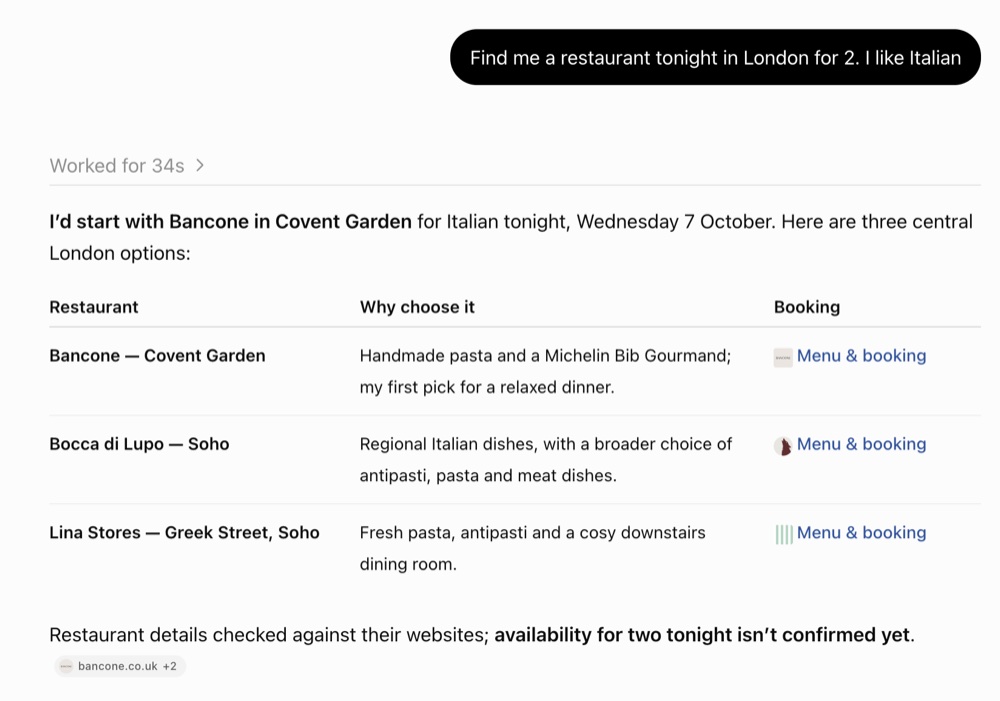
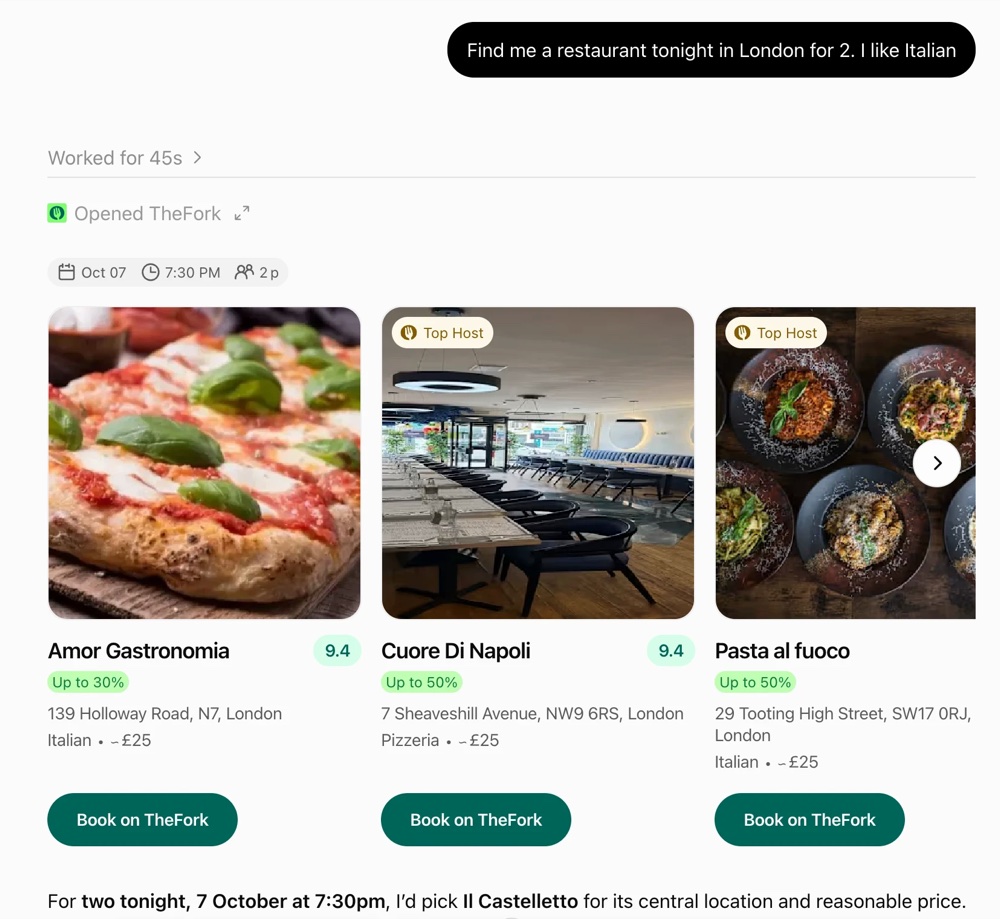
The same request, two very different responses.
To get things done, agents need more than a chat window. They are connected to tools: a registry of connectors and plugins, each one a company's product that the agent can call on, such as Booking.com, Expedia or DirectBooker for travel. Ask an agent to book a hotel or update a project and it can reach into that registry, use the right tool and finish the job inside the conversation.
Your product can now be surfaced at the moment of intent, for agents to take action
Now those tools surface on their own. When someone describes a job, the agent shows a shortlist of relevant tools at the exact moment they express intent, even if they have never heard of them. That means your brand can appear and be used right there in the conversation, without the customer ever leaving their agent.
The reach is significant. ChatGPT alone has more than 1.2 billion weekly active users, and your product can now be surfaced organically to any of them.
Here is what it looks like in ChatGPT and Claude:
 ChatGPTReal run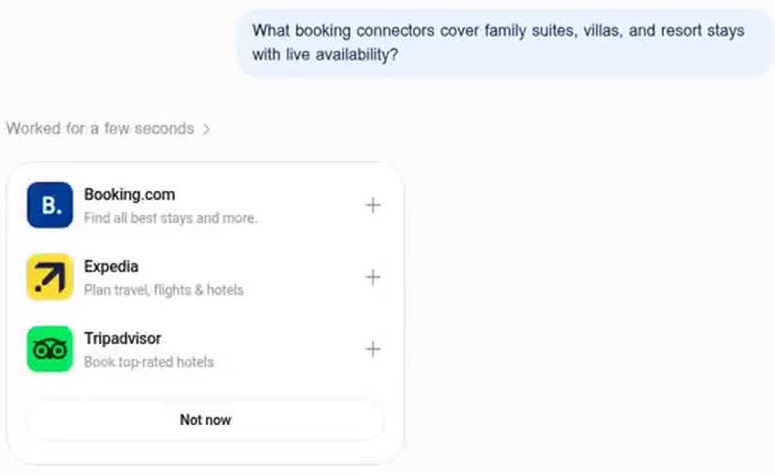
 ClaudeReal run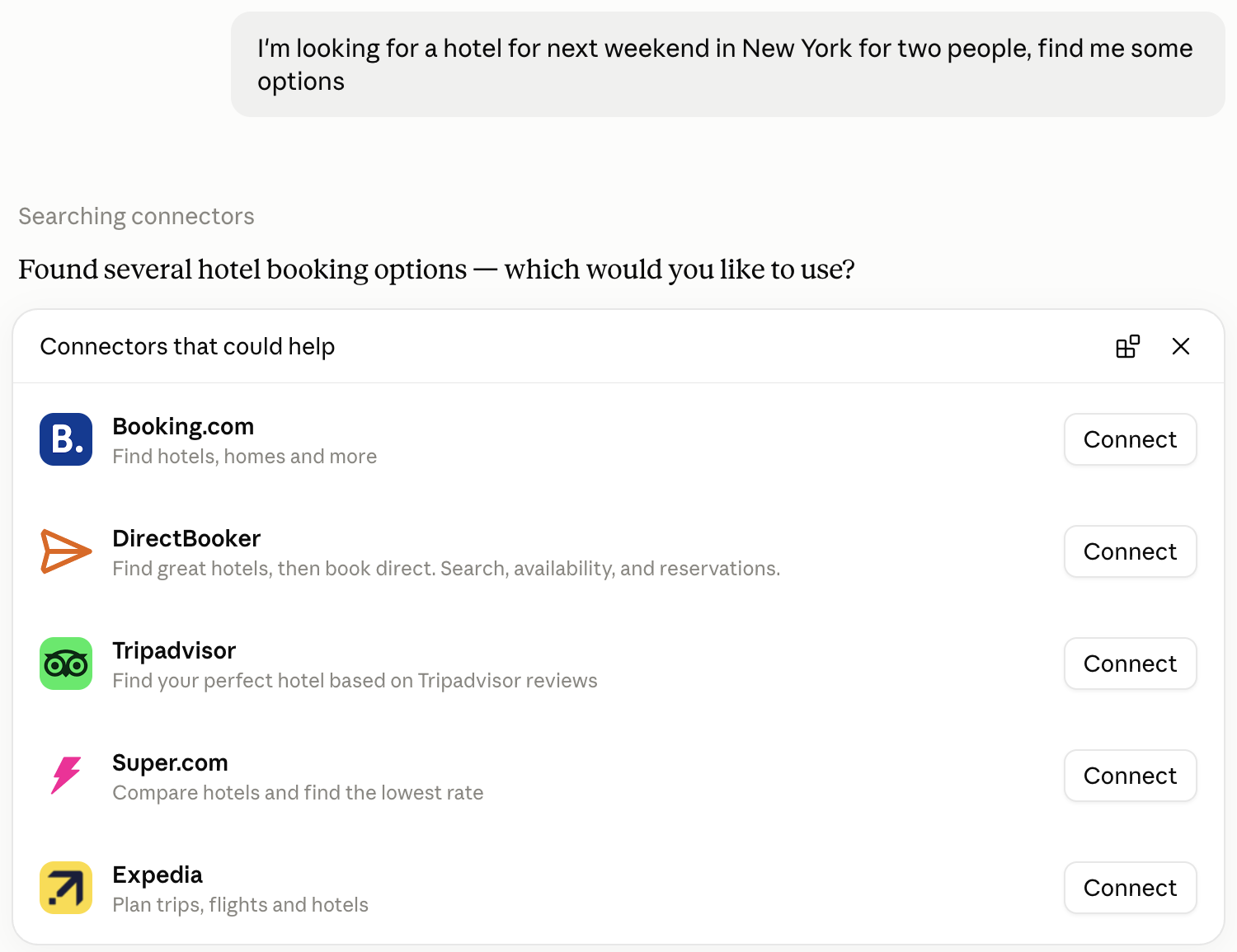
In both, the user described a job and never named a product. The agent surfaced the tools.
Every lab is heading the same way
This is not one platform's experiment. ChatGPT, Claude, Muse, Grok, Gemini and Copilot all have connector or plugin stores, and organic discovery is already live on the first three.
ChatGPTPlugin store and in-conversation suggestions
ClaudeConnector store and in-conversation suggestions
 Muse
MuseConnector store with organic surfacing
 Grok
GrokConnector store live; organic surfacing early
 Copilot
Plugin store live; organic surfacing early
 Gemini
Connector store live; no organic discovery yet
The direction is the same everywhere: an action layer built on MCP and APIs, which is surfaced organically at the moment of intent and returns a result the user can use. The products that agents can find, pick and call will win that layer.
What has happened so far
The action layer is only months old, and it has arrived platform by platform:
Claude launches its Connector registry
A directory of Connectors becomes available inside Claude.
ChatGPT Plugin store launches
Plugins are listed in a store, but users have to go looking.
Claude starts organic discovery
Claude begins surfacing relevant Connectors inside the conversation, unprompted.
Muse starts organic discovery
Meta's Muse begins surfacing Connectors at the moment of intent, five days after Meta opened its connector platform.
ChatGPT starts organic discovery
ChatGPT begins suggesting Plugins in the conversation. Every major store is now moving the same way.
That is why this layer is still so new to most teams, and why early movers have room to get ahead.
How agents decide
Given a prompt like the booking request above, an agent can take four routes to complete it.
Prompt
Book me a flight from London to New York next Friday.
The fourth route, plugins & connectors (MCP / API), is the one that lets agents act, not just answer, browse or influence.
The first three routes end in words: an answer, a page, a paid placement. The fourth ends in an action. And it brings its own machinery: a registry of tools, a search over that registry, a ranking, and a handful of winners who get surfaced at the moment a customer is ready to act, without the customer ever searching a directory or knowing your name.
That makes this more than a new channel. It is a new layer, in the same way advertising arrived as its own layer next to organic search. It is not something we have seen before, and it is not an upgrade to anything you already optimize. It has to be thought of as an entirely new layer, with its own rules.
Nor is it a niche: ChatGPT alone has over 1.2 billion weekly users, according to OpenAI. Read how it works in ChatGPT and Claude.
The shift: a new platform, a new way to optimize
We have seen this before. Every time there is a new platform, there is a new way to optimize, and each one is its own discipline with its own rules, not an upgrade of the last. Ads are not organic search, and AEO is not SEO. Agents are the next platform.
Search engines · SEO
Get found.
Show up in search results.
AI answers · AEO & GEO
Get cited.
Be the source AI answers quote.
AI agents · ATO (part of Agent Experience)Starting now
Get chosen. Get called.
Give agents plugins and connectors (MCP and API) they can call to complete the task.
Agents prefer APIs and MCP to websites, because those let them take action directly. MCP is the new technical layer for getting things done, and every major platform now keeps a registry of these tools. That is what has created a new layer to compete in.
Your MCP is becoming your product. For years a company's website was its front door. Now customers increasingly want to reach your product through their agent, and the way in is your MCP or API integration. It is becoming the action layer of the agentic web: the place where a customer asks for something and your product answers by doing the work.
We call this new layer Agent Tool Optimization (ATO): the practice of improving whether an agent finds, picks and positions your product's callable tools when it decides how to fulfil a user's intent. The term was coined by AgentDiscoverability.com in May 2025.
The call is the new click
Search gave buyers a list of links to click. Agents complete the job by choosing and using an integration. Whoever the agent calls gets the customer, and the choice happens in three steps:
Your buyer asks
The buyer gives the agent the whole job instead of browsing search results. The prompt describes the outcome they want, not a product.
The agent shortlists
 DirectBooker
 Booking.com
 Expedia
The agent considers the integrations that could complete the request and shows the buyer a shortlist of suitable options.
One gets the call
DirectBookerConnectedBooking.comExpediaThe buyer connects one, or the agent invokes one directly. That integration completes the job inside the conversation.
Step 2 is the decision ATO improves. Everything before it is the customer's intent, and everything after it belongs to the integration that won.
AEO optimizes the information layer. ATO optimizes the action layer.
You may already be working on Answer Engine Optimization (AEO), also called Generative Engine Optimization (GEO). It makes sure AI answers represent you accurately and cite you. That matters, and it is how you win the answer layer.
But it is only one layer. Here is how a prompt splits between the answer layer and the action layer:
Two layers, one prompt
Every prompt a user types lands in one of two places. Which one depends on what the user is trying to do, not on which AI they use.
Answer layer · AEO & GEO
QuestionWhat's the cheapest month to fly London to New York?
ReadTraining data and web pages
WriteOne written answer
CiteA few sources cited
AEO wins the citation.
Action layer · ATO
ActionBook me a flight from London to New York next Friday.
FindSearch the tool registry
PickKeep tools that fit the job
CallShow a shortlist or call one
ATO wins the tool call.
The layers read different inputs. The answer layer reads your web content. The action layer searches a catalog of tools and reads your tool names, descriptions and schemas. A brand can dominate one layer and be invisible in the other.
This is the most common point of confusion, so let's be direct: ATO has nothing to do with AEO. It is not a branch of AEO, an upgrade to it or its next version. It is a separate layer, in the same way advertising is a separate layer on a search page.
On a Google results page, competing in the ads is a completely different game from competing in the organic results, even though both sit on the same screen. The tools, the inputs and the winners are all different. AI interfaces now work the same way. A single conversation can contain three layers, and each has its own mechanics:
Answer layer
AEO & GEO
Get cited
Shows up via
Training data and the live web
Reads
Your content and sources
You win by
Being quoted in the answer
Ad layer
Paid ads
Get placed
Shows up via
A paid placement in the decision surface
Reads
Bids and ad creative
You win by
Paying and optimizing the ad
Action layer
ATO
Get called
Shows up via
A registry of MCP and API tools
Reads
Tool names, descriptions, schemas and usage
You win by
Being found, picked and called
Three layers, three sets of mechanics. Doing well in one does not carry over to the others.
How the action layer works differently
- 1.You can't appear without the integration. To be surfaced in the picker you need an MCP or API integration, a different technical architecture from a website. Without one, you are not in the game, however good your content is.
- 2.It runs on a different mechanism. The agent searches a registry of tools, and the platform decides which few to show and in what order. It is not retrieving and quoting web pages, so work on your text does not move it.
- 3.It rewards different signals. The agent reads your tool names, descriptions and schemas, and the platform weighs how well your tool performs once connected, such as connects, usage, retention, task completion, reliability and latency. Citations and backlinks are not part of it.
None of this makes AEO less important. Keep doing it: it is how you win the answer layer. It simply cannot win the action layer, because it is a different game.
AEO vs ATO at a glance
Both matter, and they are separate. They win different moments, need different things, read different inputs and are measured differently.
How ATO works and how to become more discoverable
ATO starts once you have an agent-ready integration (a Plugin, Connector or MCP app). Everything is measured in three stages, improved through discovery and product quality, and kept up on a loop.
What we measure: one prompt, three contests
A single prompt contains three separate contests. Found, Picked and Positioned describe the path from a buyer's request to the shortlist they see. We measure each stage on its own, because each fails for a different reason, and it works the same across Claude and ChatGPT.
Your buyer types
Find me a quiet beachfront hotel for next weekend.→Who gets the call?
DirectBookerBooking.comExpedia Hotels.com
 Tripadvisor
 Super.com+ other hotel Integrations
Found
The agent creates a set of integrations that could help with the request. Found tells you whether yours entered that set.
If you are not Found, you cannot be Picked.
What ATO works on: names and descriptions that match how buyers phrase the job.
Find me a quiet beachfront hotel for next weekend.→Integrations considered for this request
DirectBookerFoundBooking.comFoundExpediaFoundHotels.comFoundTripadvisorFoundSuper.comFoundPicked
The agent checks which candidates can do the job and keeps the best matches. Picked tells you whether yours reached that shortlist or was invoked directly.
Picked is the Discoverability Score.
What ATO works on: clear fit for the job, schemas an agent can call with what it has, and low sign-in friction.
Which integrations can complete the job?
DirectBooker✓Booking.com✓Expedia✓Hotels.com—Tripadvisor—Super.com—3 of 6 candidates reached the shortlist
Positioned
The shortlisted integrations appear in an order. Positioned tells you where yours appeared among the options shown to the buyer.
Position shows prominence after you were Picked.
What ATO works on: the wording and signals that decide ranking. Small changes can move you up or down.
Claude · Connectors
Choose a hotel Connector
Position and movement since the previous measurement window.
DirectBooker↑ Up 2Booking.com↓ Down 1ExpediaNo changeWhat drives discoverability
Two sets of factors drive how discoverable you are: how agents find and pick you, and how good the product is once they use it.
Discovery
How agents find and pick you. These are the things you change, and the things you check to see whether it worked.
What you change
What you look at
Product quality
How well it works once connected. Platforms watch how your tool performs, and these are the numbers that move the needle.
How to optimize and improve ATO
Improving your ATO is not a one-off rewrite. You work through the same four steps on a loop: measure how you surface for the prompts that matter, find where visibility is lost, change the factors above, and check that it worked. Then repeat. Platforms, competitors and your own product keep changing, so scores refresh daily and each pass starts from the latest results.
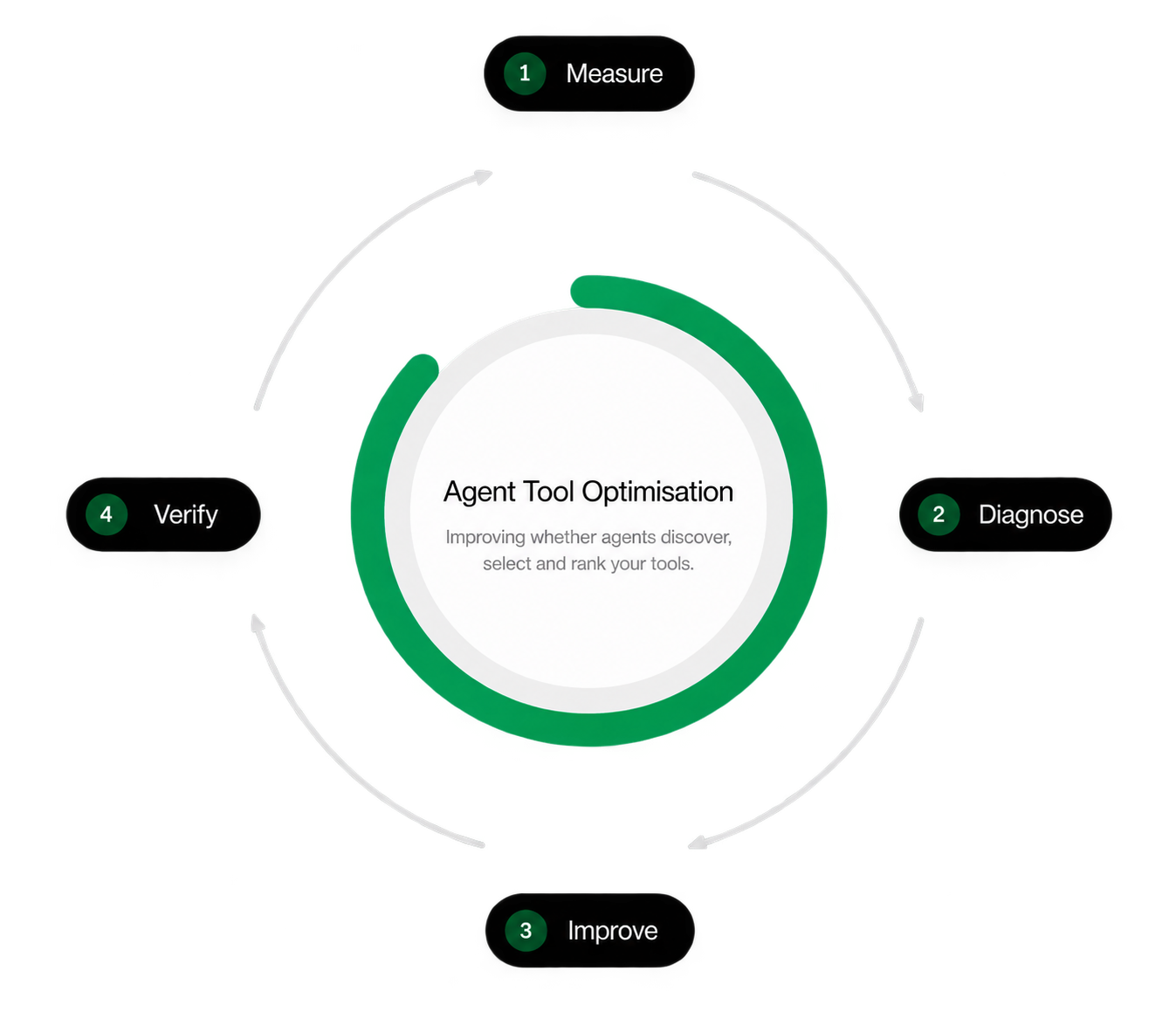
Where do we stand? Run your priority prompts many times. A single run is a sample, and platforms do not report this.
Where is visibility lost? Not Found, not Picked, or outranked. Each points somewhere different.
What do we change? Start with the biggest gap and edit the names, descriptions and schemas the agent reads.
Did it work? Re-run the same prompts and look for a consistent lift without losing prompts you already won.
How many prompts reach the action layer
This is not a niche slice of traffic, but it depends on what kind of prompt the user types. The data below is from our Research Lab. For each prompt, we recorded whether the run ended with a tool being suggested or called.
Share of runs ending with a connector or plugin shown or invoked. Source: AgentDiscoverability.com Research Lab, 12 Sep to 12 Oct 2026, free accounts in the US. The prompts are shaped like jobs, so read these as what happens for those prompts, not as an average across all conversations.
Three things stand out:
- Action prompts are where agents reach for tools. A growing number of action prompts now have a connector surfaced to carry out the request. On Claude, about four in five end with a connector shown or invoked.
- Learning prompts rarely do. "How does…" and "What is…" questions are answered from knowledge or the web, which is AEO territory. Only 25% of learning prompts on Claude ended with a connector being surfaced, and 9% on ChatGPT. The gap is widening: the share of Claude's learning prompts that surfaced a connector fell from 74% in June to 25% over the last 30 days, while for action prompts it stayed above 80%. Platforms are learning to save tools for action-shaped requests.
- ChatGPT is following the same path. Organic discovery there has only just been released, and for now only certain Plugins can be surfaced organically. See which ChatGPT Plugins can already be discovered, and their scores. We expect it to go the way Claude did: over time more Plugins become discoverable, and more companies surface for more prompts.
Put together, a large share of prompts now has an action layer attached to it, and that share is set by the type of prompt, not just the platform. Position inside that layer is decisive: in the registry searches we track, the #1 result is shown about 74% of the time and picked first about 44% of the time, falling to 16% and under 1% at rank 10. Trigger behaviour also shifts when a platform changes its model, which is why a one-off check is not enough.
Whose Plugin/Connector is discoverable today?
Not every product gets surfaced. In each category, only a handful of products are actually found, picked and called by agents, and that changes every day. Our category leaderboards show who is discoverable today on ChatGPT and Claude, and how their scores are moving.
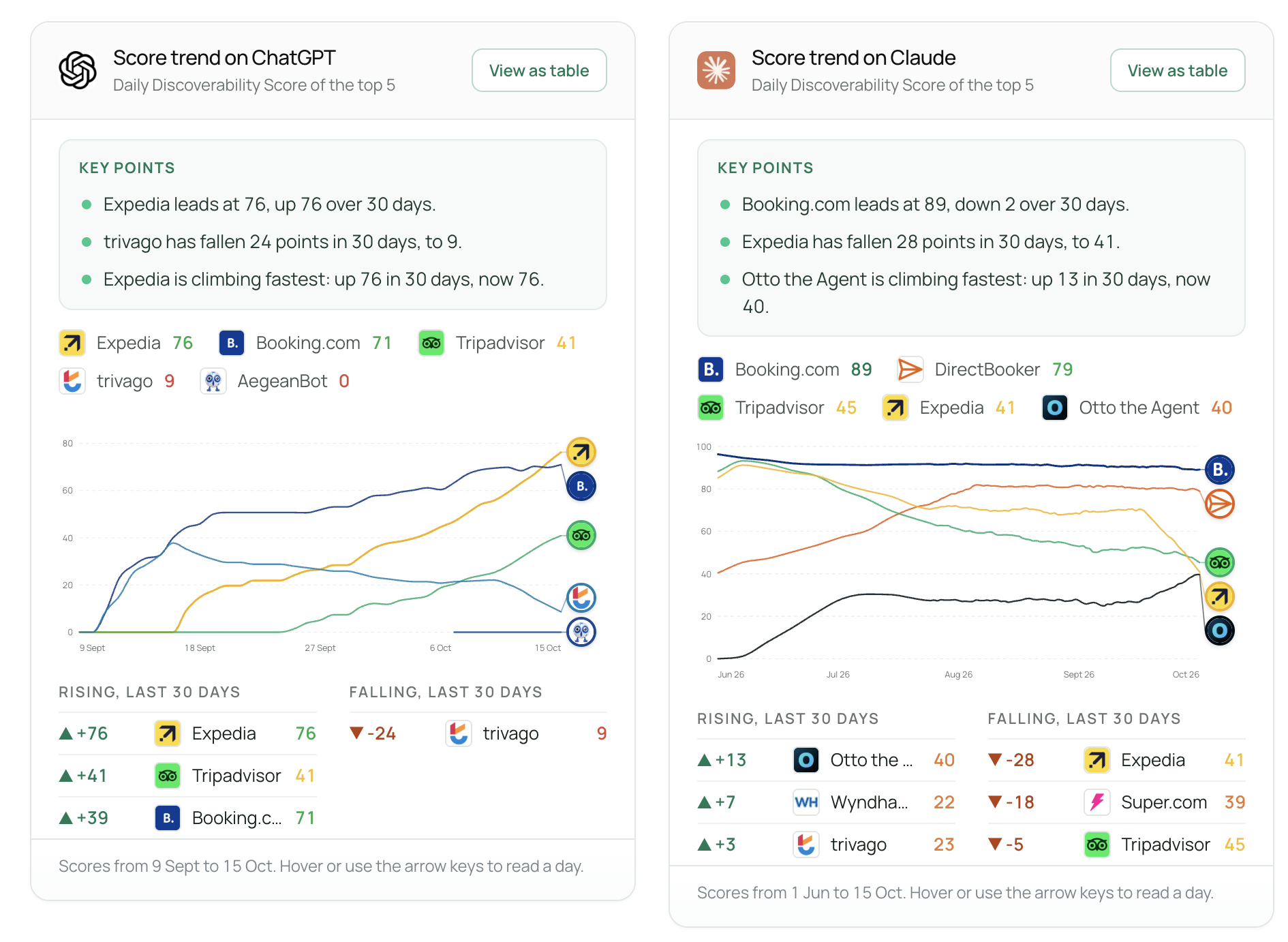
Daily Discoverability Score of the top five products in a category, up to 15 Oct 2026.
See who is leading your category and where you rank.
Explore the category leaderboards
Our Research Lab and how we test
Everything above comes from the AgentDiscoverability.com Research Lab. It runs real conversations across agent platforms, every day, to see how integrations are found, selected and used. It has tracked the ecosystem daily since December 2025 and publishes the live data, original reports and the method behind them.
of real agent runs behind our benchmarks
not claimed: results come from what an assistant actually surfaces
Each result follows the same four steps:
01
Represent real jobs
Prompts mirror the jobs buyers ask agents to complete.
02
Run live conversations
Repeated on the live platform under consistent conditions.
03
Record the outcome
Each run keeps the result and supporting evidence.
04
Review the evidence
Results can be checked against the captured conversation.
Every number carries its date, because assistants change weekly. Read the full methodology for Claude and ChatGPT.
Case studies: ATO in practice
Two companies that worked with AgentDiscoverability.com on ATO.

 Barak BengadSoftware Engineering Team Lead, monday.com
 Sanjay Vakil, PhD.CEO and Cofounder, DirectBooker
Why Agent Tool Optimization matters
If you only optimize for answers, you miss the moment someone acts. Agents now finish the job, and the products they find, pick and call win the customer.
- The call is the new click. Whoever the agent calls gets the transaction.
- AEO work does not transfer. Strong content and citations will not get you into the picker.
- Live is not discovered. Publishing a Plugin or Connector makes it available, not chosen.
- Position compounds. The tools agents already trust are the ones they keep calling.
- It is early. There are only a little over 5,000 connectors across Claude and ChatGPT, and only 59 are discoverable there. That is a huge number of prompts with very limited competition.
Next steps
- 1.Build your MCP. This is what agents call. Here is how to build a ChatGPT Plugin or Claude Connector.
- 2.Get it into the main registries. Claude, ChatGPT, Muse, Grok and Copilot.
- 3.Get it verified. Being in the store is not enough: you also need to be verified to appear organically.
- 4.Track your prompts. Understand your visibility layer, and monitor it while you wait to be verified.
- 5.Optimize. Fix and improve your MCP to increase your discoverability over time, and measure the change.
Want to improve your MCP's discoverability? Talk to our team or sign up today.
Sign up to the platform Book a call with our team →
Agent Tool Optimization (ATO) FAQ
What does ATO stand for?
Agent Tool Optimization: improving whether AI agents find, pick and position your product's callable tools. The term was coined by AgentDiscoverability.com in May 2025.
Is ATO part of AEO?
No. ATO is a separate layer, in the way ads are a separate layer next to organic search. AEO works on content that answer engines retrieve and cite. ATO works on the tools an agent finds, picks and calls. They run on different mechanics, so being good at one does not make you good at the other. We recommend doing both.
If ChatGPT already mentions my company, am I covered?
No. A mention in a written answer is the answer layer (AEO). Being surfaced as a Plugin or Connector the user can connect to, and then being called, is the action layer (ATO). One does not imply the other.
Can strong AEO get my product into the Plugin or Connector picker?
No. You cannot appear there without an MCP or API integration, and the picker is filled by searching a registry of tools, not by retrieving web pages. Work on your text and citations does not move it.
Are there rankings I can look up?
No. Platforms do not publish rankings or leaderboards for these prompts. We measure by running live prompts in the real clients and recording which tools appear and in what order. Results differ by client, for example ChatGPT free, ChatGPT paid, Codex and Claude, so we test each separately.
Does personalization or memory change what gets surfaced?
It can. The tools a user has already connected can change what is surfaced. We start with a baseline for new users and add connected-user and memory scenarios later, because they are harder to set up and interpret.
How new is this?
Very. ChatGPT opened up to Plugins in October 2025, Claude began surfacing Connectors organically in April 2026, Muse followed, and ChatGPT began suggesting Plugins organically at the end of September 2026. Few teams have worked this out yet.
Do I need ATO if I already do SEO?
Yes, if agents will complete tasks in your category. SEO and AEO work on web content. Tool selection runs over platform tool catalogs and reads names, descriptions and schemas.
What do I need before I can start?
An agent-ready integration: a Plugin, Connector or MCP app that agents can call. ATO begins once it is live.
Related reading
- ChatGPT Plugin discovery: how to get suggested. How ChatGPT decides which Plugins to suggest, and how to get yours picked.
- How to get your Claude Connector discovered organically. A four-stage process to measure, diagnose, improve and verify Claude discovery.
- MCP Directory: every ChatGPT Plugin and Claude Connector. Search and compare listings, ranked and updated daily.
- Check your Discoverability Score. See how well agents find and pick your product.