
Revenue Analytics
Non-trivial RevOps reports
 View in the ChatGPT registry
- Brand
- Unknown
- Category
- Pending
- Primary Subcategory
- Pending
Integration details
Description
Revenue Analytics by DataLabs.store connects your HubSpot data to ChatGPT. It continuously replicates your portal (custom objects, deals, contacts, companies, line items, engagements, email events) into a real relational Microsoft SQL Server database whose schema matches your portal, then lets ChatGPT query it in plain English and return answers backed by the exact SQL that produced them. Why it exists HubSpot is built to run your CRM at scale, and its reporting tools are genuinely good at what they were designed for. The limit is structural: standard reports are built one object at a time, so questions that need several tables joined together before the math even starts do not fit. Per-deal margin (deals joined to their line items), multi-hop paths (deal to contact to company to source), correctly weighted stats (SUM(clicks)/SUM(delivered), not an average of averages), cohorts, and window functions all need a real database underneath. That is the job this fills. What you can ask - "Rank owners by weighted pipeline (each deal's amount times its real stage odds) and their historical win rate." - "Unique click-through rate by acquisition source, weighted by delivered volume, for contacts who became customers." - "Which deals are aging past 90 days, and where does our ARR actually concentrate?" Then keep drilling: "now split by pipeline... now only Q2... now show the trend." What makes it different - Real joins across any objects, expressed as one query. - Every answer is auditable: the exact SQL ships with the number, so you can verify and reproduce it. - You bring the model: full frontier ChatGPT reasoning runs over your own data. - Complementary to HubSpot's own AI. Breeze works inside the CRM; this understands the data behind it. A note on sensitive data This app's HubSpot integration requests only standard, non-sensitive OAuth read scopes for CRM analytics. It does not request HubSpot's sensitive scope grants (for example, crm.objects.contacts.sensitive.read). Because HubSpot enforces this at the API level, any property a customer has explicitly marked as a "sensitive data" property inside their own HubSpot account is withheld by HubSpot and never delivered to our sync process. It cannot enter the customer's synced database, and therefore cannot be returned by any of this MCP's tools, regardless of the query executed.
- Integration type
- Plugin
- Verification status
- Not applicable
- Platform
- ChatGPT
- Category
- Pending
- Primary Subcategory
- Pending
- Secondary Subcategories
- None listed
- Brand
- Unknown
- Access
- Account required
- First tracked
- 2026-09-30
- Tool count
- 13
- Geography
- US
The broad Category that contains the Primary Subcategory.
The Primary Subcategory used for this profile’s headline score.
Other Subcategories where the Integration is listed.
 Agent DiscoverabilityChatGPT Plugin Discovery Score
ChatGPT Plugin discovery is coming soon
ChatGPT can surface a Plugin when it matches a user's request.Your Plugin Discovery Score measures how often yours appears.
No spam. Unsubscribe any time.
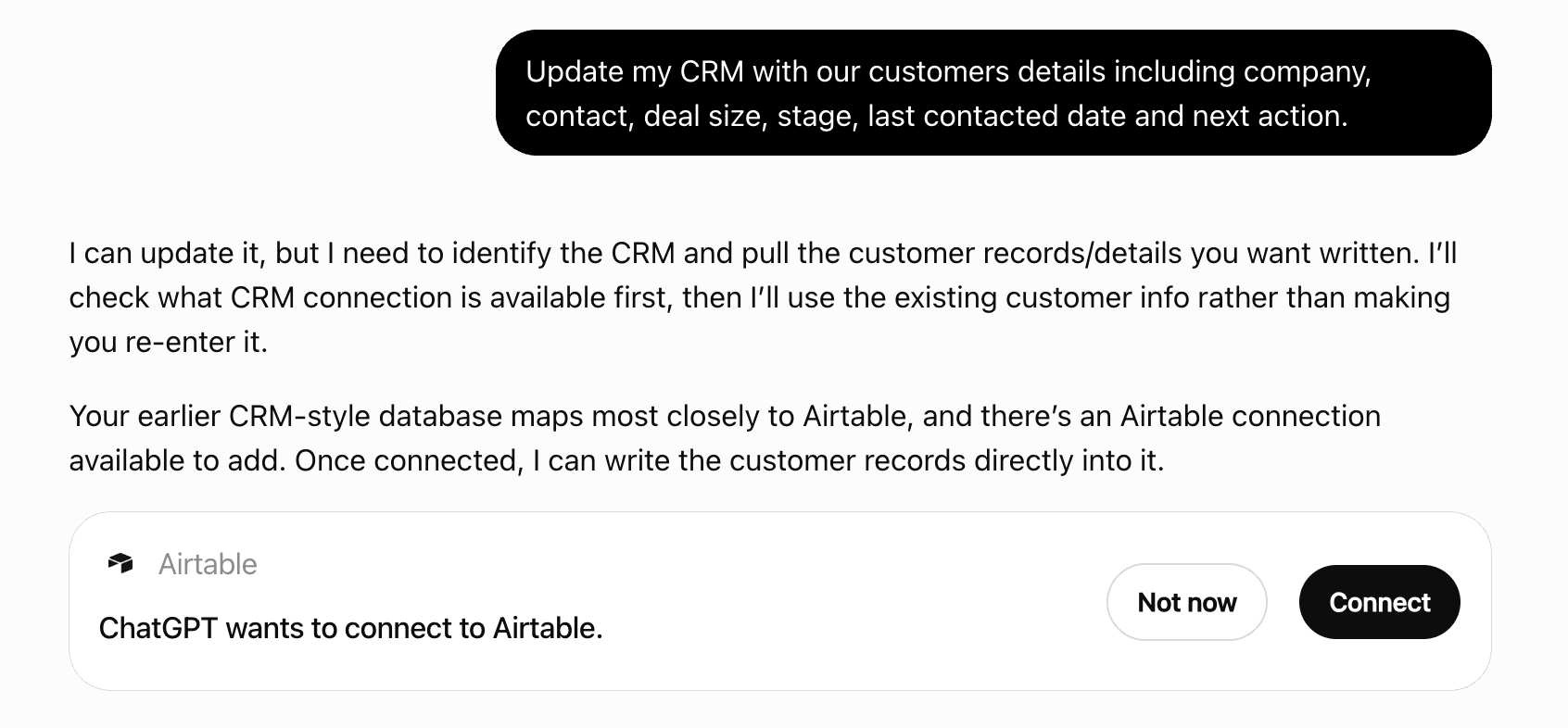
What discovery looks like
Get alerts for Revenue Analytics
Get updates when Revenue Analytics’s Discoverability Score or category rank changes.
Competitive lineup
13 tools agents can invoke

Revenue Analytics FAQ
How the directory, categories and Discoverability Score work.
Read the methodologyHow do I improve a ChatGPT Plugin's discoverability?
The levers are the listing surface agents actually read: names, descriptions, keywords, tool metadata, and registry health. Which lever matters depends on where discovery breaks, which is what continuous measurement shows.
Where is this profile measured?
This profile uses the geography attached to the latest public registry snapshot: US. Locale tags are intentionally omitted.