
AAR Maker
Run after-action reviews and postmortems in Claude from a free library of 22 cited sources, including US Army TC 25-20, the NHS Just Culture Guide and the US Forest Service Learning Review Guide.
 View in the Claude registry
- Brand
- Unknown
- Category
- Pending
- Primary Subcategory
- Pending
Integration details
Description
After an incident or a finished project, AAR Maker gives Claude what it needs to run an after-action review (also called a postmortem or post-incident review): a method to follow and a library to cite. Claude runs the review with your team. It's blameless by default and looks for everything that contributed rather than one root cause. The library holds 22 sources, each distilled for after-action reviews. Among them are US Army TC 25-20, the US Forest Service Learning Review Guide, NHS Improvement's A Just Culture Guide, the US Department of Energy's Human Performance Improvement Handbook, the Columbia Accident Investigation Board report, Liberating Structures and four OpenStax textbooks. A task index maps them to six phases of a review: scoping, timeline and local rationality, contributory factors, just-culture sorting, action design, and closing the learning loop. Claude reads AAR Maker's guide, then uses the index to pick sources for the phase you're in. From there, Claude can help you rebuild what each person knew and was trying to do at the time, work through the NHS decision tree when someone's action is in question, and match each action to the kind of error behind it. Each distillation names its source and that source's licence and marks verbatim passages, so you can check a claim against the original. All seven tools only read the library, and AAR Maker writes nothing. Your conversation stays with Claude: a tool call carries only short arguments, such as a source id or a few search words. The server logs which library file a tool read, never your search words. You sign in with GitHub, which shares your public username and nothing else. AAR Maker is free to use. Some of its sources carry non-commercial licences, and each distillation names its own. It isn't legal, safety, clinical or HR advice. Built by Chris Gagné. The server code and its facilitation workflows are open source (MIT) in grounded-forge on GitHub.
- Integration type
- Connector
- Verification status
 Community connector
- Platform
- Claude
- Category
- Pending
- Primary Subcategory
- Pending
- Secondary Subcategories
- None listed
- Brand
- Unknown
- Access
- Account required
- First tracked
- 2026-10-28
- Tool count
- 7
- Market
- US
The broad Category that contains the Primary Subcategory.
The Primary Subcategory used for this profile’s headline score.
Other Subcategories where the Integration is listed.
 Agent DiscoverabilityClaude Discoverability Score
Claude Connector discovery is coming soon
Community Connectors only appear in Claude’s registry.Once verified, organic discovery begins and we can calculate your score.Read more about Community Connector verification.
No spam. Unsubscribe any time.
What discovery looks like
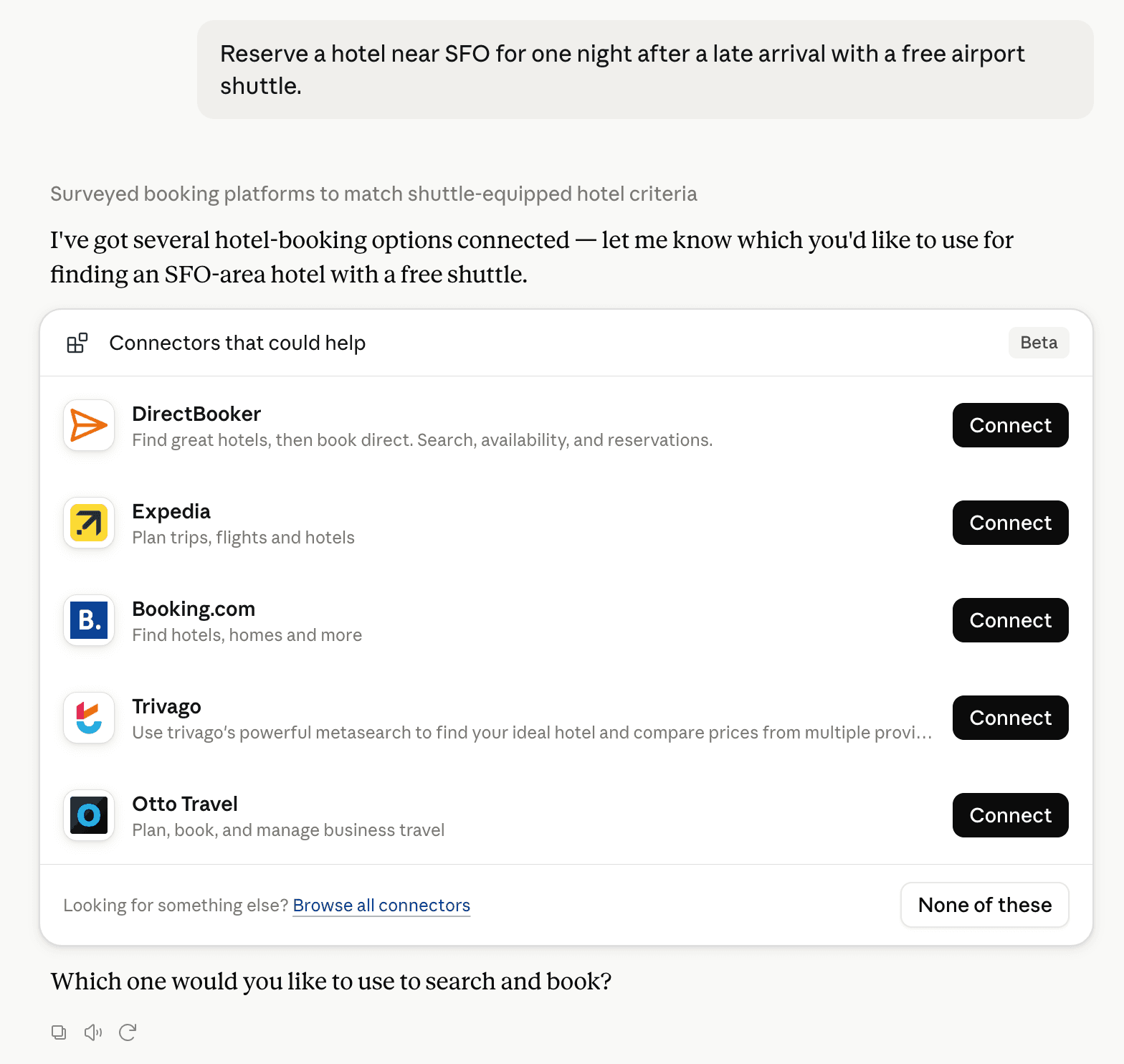
Claude can surface verified Connectors when they match a user’s Prompt.
How Claude Connector discovery works
Your Connector will compete to appear for users’ Prompts once Claude verifies it
Competitive lineup
7 tools agents can invoke

AAR Maker Claude Connector FAQ
How the directory, categories and Discoverability Score work.
Read the methodologyHow do I improve AAR Maker's Claude Connector discoverability?
The levers are the listing surface agents actually read: names, descriptions, keywords, tool metadata, and registry health. Which lever matters depends on where discovery breaks, which is what continuous measurement shows.
Where is this profile measured?
This profile uses the geography attached to the latest public registry snapshot: US. Locale tags are intentionally omitted.