
Ganttly Project Timeline
Build Gantt charts and project timelines with the critical path, float, and milestones on business days, and test how task slips move the finish date.
 View in the Claude registry
- Brand
- Unknown
- Category
- Pending
- Primary Subcategory
- Pending
Integration details
Description
Ganttly Project Timeline builds a project schedule and Gantt chart from a task list using the critical path method (CPM). It is used by project managers, team leads, consultants, and students planning a thesis. List tasks with durations, dependencies, and a start date. Ganttly returns early start, early finish, late start, late finish, and total float for each task, the critical path, milestones, and the project end date. Calendars: plan on business days that skip weekends and the public holidays of a chosen country (with regional holidays, local weekends such as Friday-Saturday, and your own days off such as a year-end shutdown), or on plain calendar days. Durations can be given in days or weeks. Dependencies are finish-to-start and can carry a lag ("Design+2") or a lead ("Build-3"). Tasks can have a start-no-earlier-than date, an owner, or be zero-length milestones. The interactive chart has a day and week axis, task bars, dependency arrows, the critical path in red, float after each bar, milestone diamonds, and a today line. Tap a task for its dates and float, and test a slip to see the new end date and critical path. What-if analysis compares up to four scenarios against the plan, for example how far a 5-day slip moves the finish and which tasks become critical. Downloads: a CSV schedule, an .ics calendar file with milestones and task start dates, and an SVG image of the chart for slides and documents. The schedule is computed by deterministic code, so the same inputs give the same dates. Dependency loops and unknown task names are explained in plain language. Example: "Make a Gantt chart starting 2026-11-02: Design 5 days; Build 10 days after Design; Test 4 days after Build; Docs 3 days after Design; Launch milestone after Test and Docs." Limitations: finish-to-start links only (no start-to-start or finish-to-finish), whole-day scheduling, and no resource levelling, costs, or progress tracking. Plans are not saved or synced with project tools.
- Integration type
- Connector
- Verification status
 Community connector
- Platform
- Claude
- Category
- Pending
- Primary Subcategory
- Pending
- Secondary Subcategories
- None listed
- Brand
- Unknown
- Access
- No account required
- First tracked
- 2026-10-03
- Tool count
- 2
- Geography
- US
The broad Category that contains the Primary Subcategory.
The Primary Subcategory used for this profile’s headline score.
Other Subcategories where the Integration is listed.
 Agent DiscoverabilityClaude Discoverability Score
Claude Connector discovery is coming soon
Community Connectors only appear in Claude’s registry.Once verified, organic discovery begins and we can calculate your score.Read more about Community Connector verification.
No spam. Unsubscribe any time.
No spam. Unsubscribe any time.
What discovery looks like
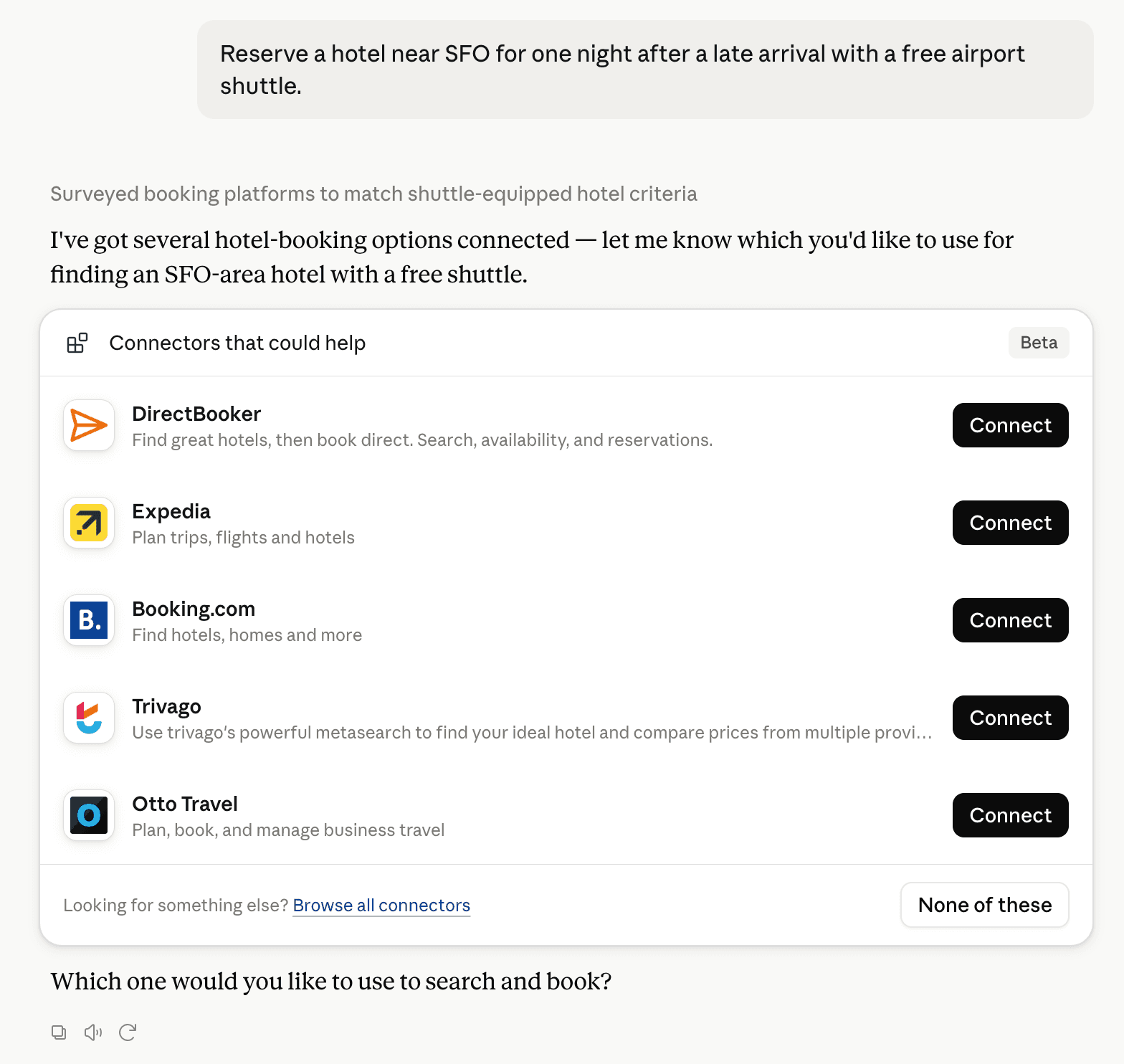
Claude can surface verified Connectors when they match a user’s Prompt.
How Claude Connector discovery works
Your Connector will compete to appear for users’ Prompts once Claude verifies it
Competitive lineup
2 tools agents can invoke

Ganttly Project Timeline Claude Connector FAQ
How the directory, categories and Discoverability Score work.
Read the methodologyHow do I improve Ganttly Project Timeline's Claude Connector discoverability?
The levers are the listing surface agents actually read: names, descriptions, keywords, tool metadata, and registry health. Which lever matters depends on where discovery breaks, which is what continuous measurement shows.
Where is this profile measured?
This profile uses the geography attached to the latest public registry snapshot: US. Locale tags are intentionally omitted.