
Rootline Family Tree
Turn a plain-language description of relatives into a printable family tree, pedigree, descendant, hourglass, or fan chart, and name how two relatives are related.
 View in the Claude registry
- Brand
- Unknown
- Category
- Pending
- Primary Subcategory
- Pending
Integration details
Description
Rootline Family Tree turns relatives described in plain language into a laid-out genealogy chart you can print, and names the relationship between two people. It is used by family historians, genealogy hobbyists, teachers running family-history projects, and people preparing reunion or anniversary posters. Give names, birth and death years, parents, and marriages. Each generation sits on its own row, couples stand side by side, children run in birth order, and remarriages keep half-siblings under the right parents. Adopted children get a dashed line, twins share a branch, divorces are marked, and people who link two branches are shown in both places with a star. The tidy-tree layout keeps boxes from overlapping for trees of up to 200 people. Chart types: all relatives on one chart, the descendants of one person or couple, a pedigree chart of one person's ancestors (up to 6 generations), an hourglass chart, or a half-circle fan chart. Downloads: vector PDF posters in US Letter, A4, A2, 18 x 24 in, and 24 x 36 in, each fitted with a title such as "The Kowalski Family"; an SVG for editing; and a GEDCOM 5.5.1 file for genealogy software. The preview zooms and pans and switches chart type. Relationship answers use English kinship terms such as second cousin once removed, half-brother, great-aunt, mother-in-law, or stepsister, with the closest common ancestors and the number of generations on each side. Example: "Make a pedigree chart for Emma Carter (born 1990). Her parents are Tom Carter (1960) and Lisa Moreau (1962)." Limitations: it does not research ancestors or search records, and it does not import GEDCOM files or photos. Charts hold up to 200 people; very large trees may need one chart per branch. Names print in Latin scripts, Greek, Cyrillic, and Japanese; Chinese, Korean, Arabic, and Hebrew names show in the SVG but not in the PDF. DNA matches are not covered.
- Integration type
- Connector
- Verification status
 Community connector
- Platform
- Claude
- Category
- Pending
- Primary Subcategory
- Pending
- Secondary Subcategories
- None listed
- Brand
- Unknown
- Access
- No account required
- First tracked
- 2026-10-03
- Tool count
- 2
- Geography
- US
The broad Category that contains the Primary Subcategory.
The Primary Subcategory used for this profile’s headline score.
Other Subcategories where the Integration is listed.
 Agent DiscoverabilityClaude Discoverability Score
Claude Connector discovery is coming soon
Community Connectors only appear in Claude’s registry.Once verified, organic discovery begins and we can calculate your score.Read more about Community Connector verification.
No spam. Unsubscribe any time.
No spam. Unsubscribe any time.
What discovery looks like
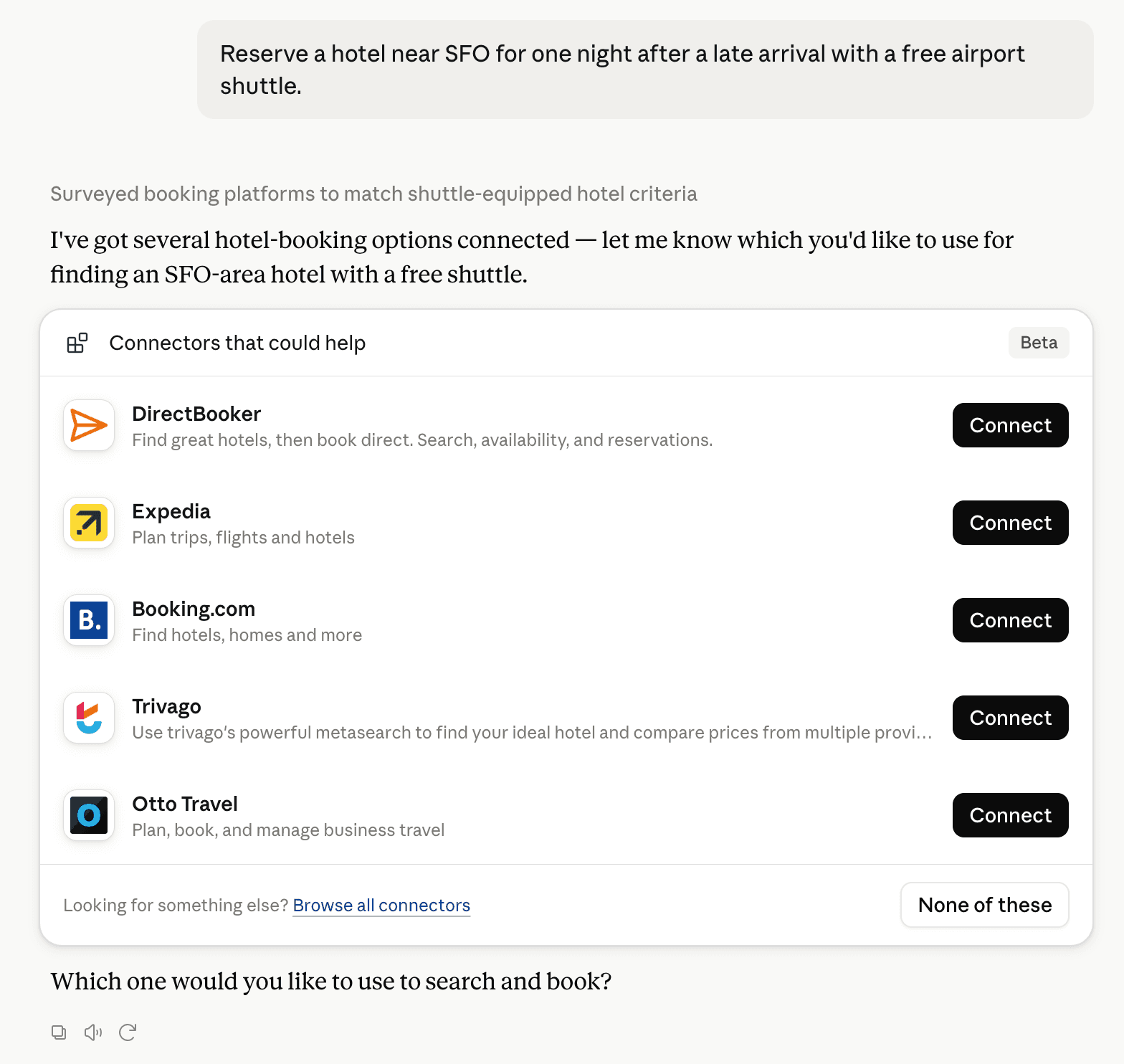
Claude can surface verified Connectors when they match a user’s Prompt.
How Claude Connector discovery works
Your Connector will compete to appear for users’ Prompts once Claude verifies it
Competitive lineup
2 tools agents can invoke

Rootline Family Tree Claude Connector FAQ
How the directory, categories and Discoverability Score work.
Read the methodologyHow do I improve Rootline Family Tree's Claude Connector discoverability?
The levers are the listing surface agents actually read: names, descriptions, keywords, tool metadata, and registry health. Which lever matters depends on where discovery breaks, which is what continuous measurement shows.
Where is this profile measured?
This profile uses the geography attached to the latest public registry snapshot: US. Locale tags are intentionally omitted.