
- Brand
- Layerz
- Category
- Finance
- Primary Subcategory
- Financial Planning & FP&A Analytics
Integration details
Description
Layerz is a structured spreadsheet for financial models, built to be driven by an AI assistant. Every line of a model is a named variable with its formula, its timeline and its dependencies, so the assistant can change an assumption and every downstream figure recomputes, instead of rewriting a sheet by hand. With Layerz in ChatGPT or Codex you can: - List and read your models: structure, formulas, dependencies and computed values for any period. - Build a new model from a description or from a template (SaaS, business plan, three statements). - Update assumptions and formulas, and see the impact on revenue, EBITDA, cash or any output. - Work on scenarios as branches, compare them, and review the version history of each line. - Import actuals from an Excel or CSV file and map them to the model. - Export a clean .xlsx with live formulas, or share a model with a collaborator. Each model carries a FINANCE.md file (currency, units, sign conventions, statement structure) that the assistant reads first, so the context persists from one conversation to the next. Who it is for: finance professionals, founders and advisors who build business plans, budgets, forecasts and deal models. Limitations: Layerz does not move money, place trades or give investment advice. It only reads and edits the models of the signed-in Layerz account. Bank and accounting connections, when the user sets them up in Layerz, are read-only imports of actuals.
- Integration type
- Plugin
- Verification status
- Not applicable
- Platform
- ChatGPT
- Primary Subcategory
- Financial Planning & FP&A Analytics
- Secondary Subcategories
- None listed
- Brand
- Layerz
- Access
- Account required
- First tracked
- 2026-10-30
- Tool count
- 29
- Market
- US
The Primary Subcategory used for this profile’s headline score.
Other Subcategories where the Integration is listed.
 Agent Discoverability
 ChatGPT Plugin Discovery Score
Your score is coming
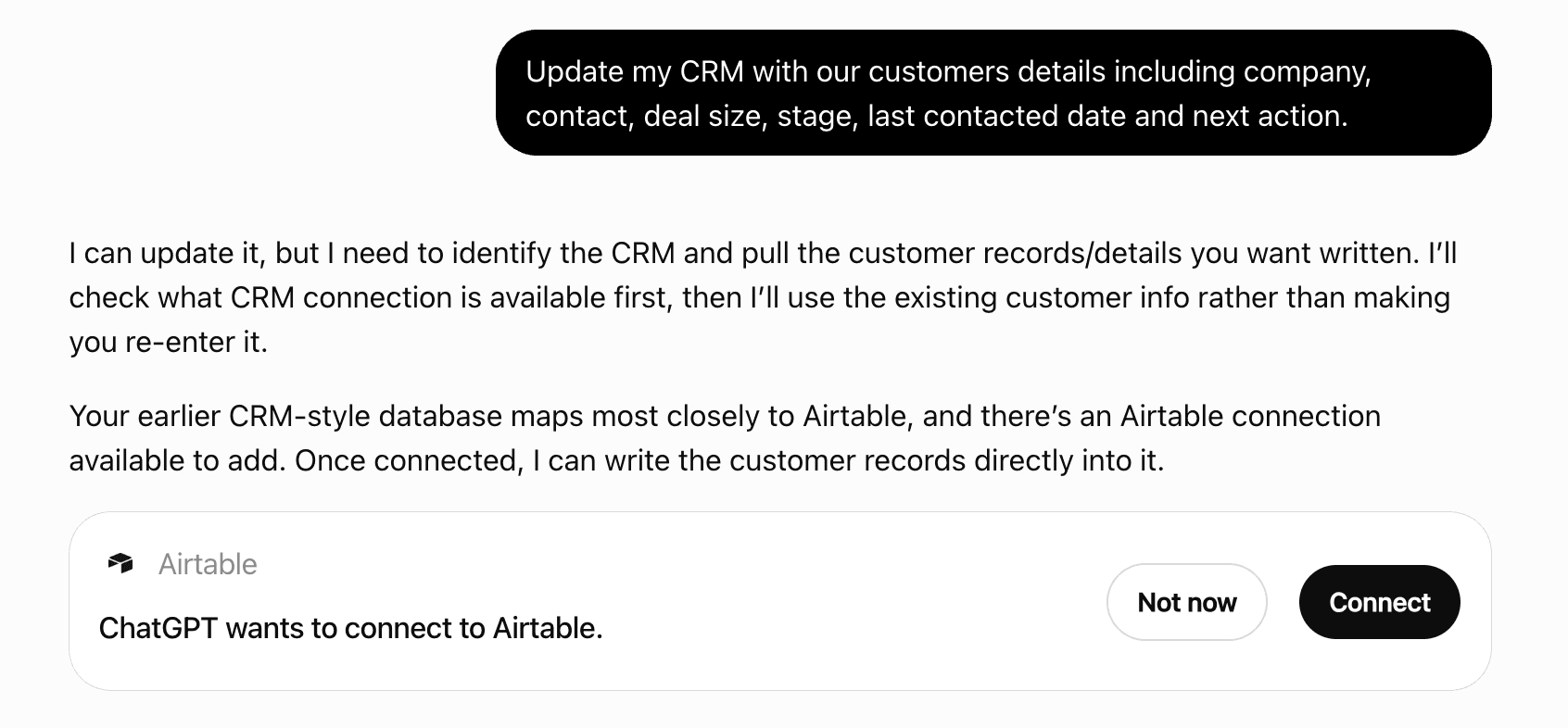
ChatGPT now suggests Plugins on its own when they match a user's request.Your Plugin Discovery Score measures how often yours appears, and it will show here as soon as it’s ready.
What discovery looks like
Get alerts for Layerz
Get updates when Layerz’s Discoverability Score or category rank changes.
Competing in ChatGPT Financial Planning & FP&A Analytics
View Category29 tools agents can invoke
Applies a batch of mutations to a model: `create`, `replace`, `update`, `delete`, `move`, `list_create`, `list_update`, `list_delete` and `meta` (name, subtitle, finance_md, timelines, formats, number_locale, default_branch, glyph). The batch is all-or-nothing: a validation failure persists nothing and returns every error at once (`MODEL_VALIDATION_ERROR`, `details[]`). A `create` may carry a temp `id` later ops reference (`parent`, `source`, `target`, `series`, `liste_ref`, `after`, `$_id` in a formula); `map` gives each temp id its UID. `replace` keeps the item's UID and presentation fields; `update` is a strict partial merge of the named fields. Root accepts `section` and `dashboard`; `dashboard` accepts widgets only; a `formula` with both an expression and children is rejected (`FORMULA_EXPR_AND_CHILDREN`); a list-mode item takes `timeline_values`, a non-list item `value` / `values` (a sparse period-keyed `timeline_values` map merges into `values`). `branch_id` routes the value writes onto that branch as an overlay of the cells differing from the base, with no data source; `compute` returns the computed series of the given UIDs (under `compute_branch`, default `branch_id`); `dry_run` validates and computes without persisting; `compare_values` adds `value_diff`, the numbers the batch moved (the `layerz_diff` values report). Persists one version labelled with `summary`. Not advertised to read-only keys. Modeling patterns and examples: resource `modeling-guide://reference`.
layerz_patch
Builds or extends a model from a strict Blueprint (whole sections with their hierarchy, items referenced by name), or applies a stored template as a module through `template_id` (mutually exclusive with `blueprint`, loaded server-side). `mode: 'merge'` (default) adds to the model, reusing items by name and keeping the presentation fields a re-declared item omits; `mode: 'replace'` rebuilds the whole model (structure, timelines, values, branches), keeping style colours, custom formats, locale, glyph, subtitle and FINANCE.md. `dry_run: true` validates and returns errors with their path without writing. Persists one version labelled with `summary`. Not advertised to read-only keys.
layerz_build_from_blueprint
Issues a 24h signed Storage URL for an Excel/CSV file and returns `file_id`, `signed_url`, `expires_at`. `signed_url` accepts an HTTP PUT of the file body with the declared content type (a shell `curl -X PUT --data-binary @file`; the binary stays out of the conversation); `file_id` is the identifier the file-consuming tools take. Limits: 25 MB, MIME whitelist (xlsx, xls, csv, json, txt). Mints no model data, so it stays available to read-only keys.
layerz_create_upload_url
Creates a model and returns its detail with its UUID, in `workspace_id` (a workspace the caller belongs to; default the personal one) where every member of that workspace edits it. `template_id` copies a template (official, or from the library of a workspace the caller belongs to) into the new model with its sources, staged transactions and mapping rules under fresh ids (connector credentials excluded); the template itself is unchanged, `timelines` sets its bounds, `glyph` its emblem (a kebab-case Lucide icon name, e.g. SaaS `trending-up`, banking `landmark`, real estate `house`, coffee shop `coffee`, energy `wind`, HR `users`, valuation `scale`, treasury `wallet`). Rejected past the plan model cap. Not advertised to model-scoped or read-only keys.
layerz_create_model
Creates or updates a branch. With `dataset_id`, patches that branch's metadata (`display_name`, `priority`, `source_hint`, `file_name`, `actuals_through`). Without it, the branch named `patch.display_name` is updated when it exists and created otherwise, with no data source and no input rows (values are then written with `layerz_patch { branch_id }`). `priority` is rejected on the default branch. An explicit `actuals_through` pins the real/forecast cutover (`actuals_through_locked: true`: source syncs stop rewriting it); `null` resets it to auto. Returns `{ branch, created }`. Persists one version labelled with `summary`. Not advertised to read-only keys.
layerz_update_branch
Deletes a branch, every input row tagged with its `dataset_id`, and the data sources that fed only that branch (their staged transactions with them); a source shared with another branch is detached instead. The default branch is rejected. Returns `deleted_dataset_id`, `inputs_removed`, `sources_removed`. Persists one version labelled with `summary`. Not advertised to read-only keys.
layerz_delete_branch
Returns the semantic diff between two revisions of a model: `{ from, to, diff: { items: [{ uid, displayName, status, fields? }], branches: [{ id, display_name, status?, items }], metadata: [...], summary: { added, removed, modified, branches } } }`. `items` compares the base plan; `branches` lists, per branch, the overlay cells it records over the base (`value` / `values` / `timeline_values`, `null` where the base shows through) — a write under `branch_id` or an import on a branch appears there, not as a base change. `from` and `to` each take exactly one of `revision_id`, `version_number` or `id`; without `to`, the diff runs against the live model. `sources` carries the delta of the source settings and bindings (`sources[] { id, display_name, status, fields[] }`) and of the mapping rules (`rules { added, removed, changed }`), present when both endpoints carry that state. `values: true` adds `values`, the computed-values diff: `{ granularity, scope, tolerance, computable, items: [{ uid, display_name, status?, changed, cells: [{ period, before, after, delta }] }], summary: { items_compared, items_changed, cells_changed, max_abs_delta, truncated } }` — the periods whose value moved beyond `tolerance`, on the lines `uids` names, else the key lines (checks and totals), else every value line; computed on the base plan or under `branch_id`, at `granularity`. `computable: false` with `errors` per endpoint when a revision cannot be evaluated.
layerz_diff
Generates a file from a model and returns `{ download_url, filename, size, file_id, expires_at }`. `target: 'model'` (default) is the Excel workbook (the same export as the web app: Intro + per-section sheets, native charts and dashboards, live formulas), plus `structure_hash` / `values_hash`; when the model has branches, the statements and single-value widgets follow `branch_id` (default: the base branch) while dashboards keep every branch they break down by. `target: 'transactions'` is the full staged import of the data source `source_id` as a CSV file (no filters, no routing annotations), plus `row_count`. Each call persists a new private file in Storage, where the file and its signed `download_url` expire after 24h; the model itself is not modified, so the tool stays available to read-only keys, off quota.
layerz_export
Returns the conventions the tools' values are expressed in: `custom_instructions` (the conventions of a workspace, the standing instructions for AI agents its members share, ≤ 3000 chars, empty string when unset; also delivered in the handshake instructions), `workspace` (`{ id, name, kind }`: the targeted model's workspace when the caller is a member of it, else `workspace_id`, else the personal workspace) and, when a model is targeted, `finance_md` (the model's FINANCE.md: `raw` Markdown, `source`, `spec_version`, parsed `front_matter` with currency / units / sign convention / glossary, `validation_errors`; `null` when the model has none). `include_guide: true` adds `guide`, the modeling guide (session workflow, structure, stock-flow, lists, branches, sources, templates, checks, versions; also the resource `modeling-guide://reference`).
layerz_get_conventions
Returns the full detail of a model: items, lists, timelines, custom `formats`, `number_locale`, `glyph`, `revision_id` (sha256 fingerprint) and `version_number`, plus `branches[]` (id, display_name, priority, actuals_through, actuals_through_locked) and `sharing` with the roster (`members[]`: owner, collaborators and pending invites with their roles and ids, `is_owner`, `link_visibility`: `invite` = sign-in required, `public` = anyone with the link reads it). Larger payload than `layerz_read`, which returns a filtered snapshot.
layerz_get_model
Writes values onto a branch of the model, creating the branch when `branch.id` names none (`branch.display_name` required then; `branch.actuals_through` sets its cutover). Two sources, mutually exclusive: `entries[]` (one value per item and period; items resolved by `item_uid` or `item_label`, created as assumptions when absent; `entry_uid` / `entry_label` target one entry of a list-mode item) or `file_id` (an uploaded spreadsheet parsed server-side, each row classified with the model's mapping rules; `sheet_name`, `structure_override`, `replace_source_id` refine the parse). An entry's `timeline_ref` equals the target item's grain or `constant` (any other grain is rejected); on a `formula` / `balance` it is a per-period override; on a `callup` it lands on the source (`redirected`). A data source is materialized on the `file_id` path and when `record_import` is given; bare `entries[]` write a manual overlay with no source. `replace: true` (with `branch.id`) wipes the branch's rows before writing, uncovered periods keeping their prior value; `merge: true` upserts cell by cell; `dry_run: true` returns the impact (`would_persist: false`, `overridden_items`, `validation_errors_new`) without persisting. Returns `dataset_id`, `created_items`, `matched_items`, `entries_written`, `inputs_written`, `inputs_removed`, `warnings` (plus `skipped`, `mapping_drift`, `file_structure` on the file path). Persists one version labelled with `summary`. Not advertised to read-only keys.
layerz_import_branch
Changes who can access a model, by `op`. `invite` (default): grants `email` the role `viewer` (read-only, default) or `editor`; a registered user gets an active share, an unregistered one a pending invite; both receive an email. `revoke`: removes the collaborator or pending invite `principal_id` (an id from the `sharing.members` of `layerz_get_model`). Owner-only. The link visibility (`invite` / `public`) is changed by the owner in the web app only. No version is persisted. Not advertised to read-only keys.
layerz_share_model
Manages the links from this model to items of other Layerz models (an external ref, like an Excel linked workbook), by `op`. `link`: creates (or retargets, with `uid`) a non-list assumption whose `values` hold a snapshot of the source item's computed series projected to this model's grain (`null` outside the source's coverage); requires read access to the source model; the line is referenceable in formulas like any assumption; up to 200 links in `links` (one form per call) load each source once, are validated whole (one failure writes nothing) and return `results`. `refresh`: re-reads every linked source (or `uids`) and rewrites the snapshots, the only way the values move; a per-link failure (source or item gone) leaves the stored values intact; when values change, the pre-refresh state is snapshotted first (`Auto-backup before refresh`). `unlink`: detaches the line `uid`, keeping its values as an ordinary assumption. A self-link is rejected; a cross-model cycle resolves one hop per refresh. Link status and staleness: `layerz_list_integrations { include_external_refs: true }`. Persists one version labelled with `summary`. Not advertised to read-only keys.
layerz_external_ref
Lists every data source feeding a model: API connectors (Qonto, Pennylane, Stripe, Airtable, Metabase) and file imports (kind csv | fec), each with kind, display_name, `branch_ids` (the branches it feeds), sync status, last_synced_at and `source_fields` (the payload fields an API connector's `field_map` can re-point its description / category / account_number to; null when there is nothing to choose). A row with `legacy_import_id` is a materialized pre-staging import that owns input rows but staged no transactions. `include_external_refs: true` adds `external_refs`: the links to items of other Layerz models, each with a value-aware `stale` flag (the source moved in a way that changes the snapshot) and its source health. Stored credentials are not returned.
layerz_list_integrations
Lists the import classification rules in scope for a model: `sets` (each with a `scope`: `model` = the model's own rules, `system_template` = the curated country catalogs (PCG, US GAAP, UK, SKR03/04), `user_template` = the reusable catalogs of the caller's workspaces), `mappings` (every effective rule: pattern → target item, sign, source scope; `total` counts them) and `templates` (the catalogs importable through `layerz_manage_mapping { op: "import_template" }`). A model classifies with its own `model` rules only; a catalog applies once imported. A `pattern` is a case-insensitive glob where `*` matches anywhere. `include_user_mappings: true` adds the catalogs of the caller's workspaces to `sets` / `mappings`; `include_coverage: true` adds per-rule `match_count` and a `coverage` block (auto-created count, ignored count, the top keys routing nowhere).
layerz_list_mappings
Lists the models the authenticated user can access, and the workspaces they belong to (`workspaces[]`: id, name, kind personal | team, role admin | member, plan). Each model carries `workspace_id`, `can_write` (owner, workspace member or editor guest), `url`, `glyph` and `sharing: { shared, member_count, link_visibility }`. `q` filters by name (case- and accent-insensitive substring, `*` wildcard), `writable: true` keeps owner/editor models only. A model-scoped key gets its bound model only.
layerz_list_models
Returns a data source's staged transactions (API connector or csv/fec file import) annotated with their routing: the target item and whether a `rule` or an `auto`-created item matched, the skip reason otherwise (mapping is the only routing path, no fuzzy match), or `ignored` for a row an `__ignore__` rule routes nowhere on purpose. `period` (YYYY-MM) and `q` (substring on description/category) filter the rows. The full staged import as a CSV file is `layerz_export { target: 'transactions' }`. A materialized legacy import derives one row per owned cell from the model's input rows.
layerz_list_transactions
Lists the model templates the caller can start from: the `official` templates curated by Layerz and the `workspace` templates of the caller's workspaces (each workspace's library, read by its members and not by its guests; `workspace_id` names it). A template is a read-only copy published from a model in the web app; this tool reads it and changes nothing. Each entry carries name, subtitle, glyph, `description` (the template's FINANCE.md, its usage guide), scope and a structure summary (section names + item count). With `template_id`, returns that single template in full, `blueprint` included. A template forks into a new model through `layerz_create_model { template_id }` and applies as a module through `layerz_build_from_blueprint { template_id }`.
layerz_list_templates
Returns the version history of a model, newest first: `{ current_revision_id, current_version_number, history_days, hidden_count, oldest_hidden_at, pinned_count, max_pinned_versions, versions: [{ revision_id, version_number, created_at, trigger_type, actor_user_id, label, conversation_id, pinned }] }`. Each version is a full snapshot persisted at one mutation boundary; `revision_id` (sha256 of the snapshot) is stable while the model is unchanged. Versions older than the plan window are counted in `hidden_count` but not listed; pinned versions stay listed whatever their age. `limit` and `since` scope the list. With `uid`, returns instead that item's change events across the history: `{ uid, events: [{ revision_id, version_number, created_at, actor_user_id, trigger_type, status: added | removed | modified, fields?: [{ field, oldValue, newValue }], branches?: [{ id, display_name, status, fields? }] }] }` — `fields` describes the base plan, `branches` the overlay cells a branch records over it (a write under `branch_id` or an import on a branch lands there, not in `fields`).
layerz_history
Resolves free-text labels (e.g. row labels of a parsed file) to existing item UIDs of a model: the top 3 candidates per label across exact_uid, exact_name, slug and fuzzy (Levenshtein) methods, each with a score. An empty candidate list means no existing item matched. Deterministic, no LLM call.
layerz_match_items
Parses an uploaded Excel/CSV (`file_id`) deterministically and returns a token-optimized structure: sheet summaries (without `sheet_name`) or, for one sheet, the detected timeline, `suggested_structure` (layout, header row, columns), row labels and column headers with samples. A wide sheet is recognised by its period header: a run of at least three consecutive periods (bare years such as `2026`, `YYYY-MM`, `Jan 2026`, `Q1 2026`, date cells) in any column, reported as `detected_periods` and `period_range`. A raw DATEV EXTF export and a French FEC (compact `YYYYMMDD` dates, prior-year opening entries moved into the first month) are detected natively. `structure_override` re-parses with corrected columns when a ledger is misdetected (a Débit column taken as the value, an account-code column taken as the label) or when a wide sheet has fewer than three period columns (`layout: "wide"`). The raw binary is not returned.
layerz_parse_file
Acts on one version of a model (`version`: exactly one of `revision_id`, `version_number`, `id`) by `op`. `pin`: keeps the version listed, diffable and restorable beyond the plan history window; capped per plan (`max_pinned_versions`, 403 past the cap); a no-op on a pinned version. `unpin`: frees the slot; a version past the window then stops being listed. `restore`: replaces the live items, schema and inputs with that snapshot, and puts back the source settings (window, keys, bindings) and the mapping rules as they stood at that version, after saving the current state as a `restore` backup version (`backup_version_id`, `null` when the live state already matched the latest snapshot); requires `summary`, the label of the restored state. Returns `{ ok, version_id, version_number, revision_id, pinned, pinned_count, max_pinned_versions }` for pin / unpin, `{ ok, restored_version_id, restored_version_number, restored_revision_id, backup_version_id, sources?: { sources_restored, rules_written, rules_removed }, warnings[] }` for restore — `warnings` names what could not come back (a source deleted since, a rule whose target is gone, a version written before source versioning). The target is inside the plan window or pinned. Not advertised to read-only keys.
layerz_manage_version
Returns a UID-native snapshot of a model: `model` (name, timelines, lists, branches), `items` (flat, `parent_uid` carries the hierarchy, each with role, formula, check, note) and `revision_id` / `version_number`. Filters: `uids`, `roles`, `include_children`. `with_values: true` adds the computed series `v` aligned with the periods `p` (`periods` for explicit labels of mixed grains, else `granularity`), `variance` adds `vv`, `per_element` adds `ve` for list-mode items, `health` adds the check report, `branch_id` computes `v` and `health` under one branch's `[base, branch]` checkout instead of the stacked view. The check report is judged on a branch checkout, not the stacked view: without `branch_id`, a multi-branch model reports the branch it opens on (`health.branch_id`) and every branch under `health.by_branch`. When the response leads with `computable: false`, `errors[]` names the broken dependencies (e.g. `CIRCULAR_DEPENDENCY`) and every series is a zero-filled placeholder.
layerz_read
Replaces the FINANCE.md attached to a model with the given Markdown (YAML front matter + body, ≤ 5,000 chars). `source: 'imported'` marks content synced from a project-root file, `'user'` (default) content authored in place. The content parses as a YAML front-matter document; schema warnings are returned without blocking. A template is a read-only published copy and is out of this tool's reach; a model's FINANCE.md becomes a template's usage guide when the model is published from the web app. Persists one version labelled with `summary`. Not advertised to read-only keys.
layerz_set_finance_md
Replaces the conventions of a workspace (the personal one by default, or `workspace_id`): the standing instructions for AI agents its members share (plain Markdown/text, ≤ 3000 chars; an empty string clears them). They apply across every model of the workspace, on top of each model's FINANCE.md, and are delivered in the handshake instructions of the next session. Any member may write them. No version is persisted. Not advertised to model-scoped or read-only keys.
layerz_set_custom_instructions
Writes the model's classification rules by `op`, in its single mapping set (created on first use). `set`: creates or updates rules identified by (`source_id`, `pattern`, `secondary_pattern`), one rule from the flat fields or up to 500 in `rules` (one form per call). `pattern` is a case-insensitive glob where `*` matches anywhere (`Apport*`, `*641`, `601000`) tested against the source's primary key; `secondary_pattern` (default `*`) against its secondary key; `source_id` (required) is the data source the rules classify; `target` is an item name or uid, `uid::entryUid` for one entry of a list-mode item, or `__ignore__` to route matching rows nowhere; `sign` (natural | negate | absolute) adjusts the amount. The batch is validated whole first (empty pattern, foreign source, target matching no item or several, repeated key): one failure writes nothing. Each rule reports `created`, `updated` or `unchanged`, with `totals`; a replay writes nothing. `delete`: removes `mapping_id`, or every id of `mapping_ids` (up to 500). `import_template`: duplicates the rules of the catalog `template_id` into the model set for `source_id`, targets translated by item name; a conflicting imported rule overwrites the model's, reported in `overwritten`. A rule change applies to the projected values on the next `layerz_manage_integration { op: "sync" }`. Rules are versioned: the call writes a version labelled with `summary`; a version restore puts them back. Not advertised to read-only keys.
layerz_manage_mapping
Runs one operation on a data source (API connector Qonto, Pennylane, Stripe, Airtable, Metabase, or a csv/fec file import) by `op`. `sync`: pulls the provider's rows into the bound branch as a replace of this source's own rows (the baseline is untouched); on a file source, replays the projection over the staged rows; `target_branch_id` lands a still-unbound connection on an existing branch; `dry_run: true` reports the impact without persisting. `rebind`: re-points the source at `branch_ids`, wiping its rows from detached branches and reprojecting into the new ones. `update`: renames the source (`display_name`) and/or applies `config` then replays the projection; a change of `import_level` or of a tabular mapping (`field_map`, `measures`, `sign_rule`) re-fetches and re-stages, and is rejected on a csv/fec file source. `delete`: disconnects the source, drops its staged transactions and purges everything it projected into the model (input rows, provenance, import entry); items and the branch are kept, emptied; when the purge would destroy values the source cannot re-project, the call is refused with `PURGE_CONFIRMATION_REQUIRED` and a `purge_preview`, and a retry with `confirm_purge: true` performs it. Every projecting op returns `unmapped`, `proposed_window`, `deletable_items` (reported, not removed), `cutover_changes`, `shadowed`, `warnings`. Credentials stay in the web app. Persists one version labelled with `summary`. Not advertised to read-only keys.
layerz_manage_integration
Returns an item's dependency graph, like Excel trace precedents / dependents: `precedents` (items its formula references) and `dependents` (items referencing it). `depth` (1–5) walks transitively, `direction` restricts to one side.
layerz_dependencies
Runs the core model validator (structural / formula / timeline checks) without writing and returns `{ ok, error_count, warning_count, errors[], warnings[] }`; each issue carries a `code` (e.g. `UNKNOWN_UID`, `CIRCULAR_DEPENDENCY`, `INVALID_ROLE_CHILD`, `TIMELINE_MISMATCH`), a `message` and `item_uids`. The write path auto-repairs some of these issues and enforces a few invariants this audit skips, so `ok: true` is a sanity signal rather than a write guarantee.
layerz_validate_model
 Recommended guideHow to get your ChatGPT Plugin suggestedFollow the practical steps agents use to find, shortlist, and choose your Plugin.Read guide
Layerz ChatGPT Plugin FAQ
How the directory, categories and Discoverability Score work.
Read the methodologyHow do I improve Layerz's ChatGPT Plugin discoverability?
The levers are the listing surface agents actually read: names, descriptions, keywords, tool metadata, and registry health. Which lever matters depends on where discovery breaks, which is what continuous measurement shows.
What are Layerz alternatives on ChatGPT?
As of 2026-10-30, Layerz competes with Aleph, Alvore Finance, Cash Flow Frog, CashflowPot, Centry Adviser Coordination, Centry Global Cashflow, Centry Global Estate Planner, Codon Valuation and 22 more in ChatGPT Financial Planning & FP&A Analytics, ranked by public Discoverability Score.
Where is this profile measured?
This profile uses the geography attached to the latest public registry snapshot: US. Locale tags are intentionally omitted.