
Baseshift
Spin up masked, subsetted clones of your Postgres, MySQL, or MongoDB database in seconds, with no infrastructure changes, self-hosted or in the cloud.
 View in the Claude registry
- Brand
- Baseshift
- Category
- Developer Tools
- Primary Subcategory
- Databases & Backend Data Stores
Integration details
Description
Baseshift gives developers and AI agents safe, production-like database environments. This connector lets Claude operate Baseshift end to end, so you can go from your existing database to a clone you can test against without leaving the conversation. What Claude can do with it: - Connect your existing database. Create a Baseshift Dub from your Postgres, MySQL, MariaDB, or MongoDB instance, or from the built-in demo database. Like dubbing a movie, dubbing your data gives you a prod-like version that's safe to share: a dub is your source database plus its masking and subset policies and a snapshot schedule. No infrastructure changes are required: point it at the database and run the source health check. - Keep data inside your network. With a self-hosted dub, replication, masking, and subsetting all run on your own Kubernetes cluster, so production data never leaves your environment. Claude returns the Helm values and install command; you run them. - Define masking and subset policies. Mask sensitive columns such as names or emails with generated values. Subset to just the slice you need, for example a single tenant or the last three months of data, so clones stay small and fast instead of carrying all of production. - Take snapshots. Create tagged snapshots that bake in the current policies, so every clone starts from fresh compliant data. - Spin up clones in seconds. Start server clones from any ready snapshot and release them when you are done. Each clone is a full, isolated database you can read and write freely. - Run clones as Docker images. Every snapshot can be pulled as a Docker image and connected to any workflow, from local development to CI. Good to know: clone connections for Baseshift Cloud dubs are opened by the Baseshift CLI on your machine over a secure tunnel. The connector prepares everything and returns the exact command to run. Managing dubs and policies requires a full organization user, clone operators can start clones.
- Integration type
- Connector
- Verification status
 Community connector
- Platform
- Claude
- Primary Subcategory
- Databases & Backend Data Stores
- Secondary Subcategories
- None listed
- Brand
- Baseshift
- Access
- Account required
- First tracked
- 2026-10-20
- Tool count
- 20
- Geography
- US
The Primary Subcategory used for this profile’s headline score.
Other Subcategories where the Integration is listed.
 Agent DiscoverabilityClaude Discoverability Score
Claude Connector discovery is coming soon
Community Connectors only appear in Claude’s registry.Once verified, organic discovery begins and we can calculate your score.Read more about Community Connector verification.
No spam. Unsubscribe any time.
No spam. Unsubscribe any time.
What discovery looks like
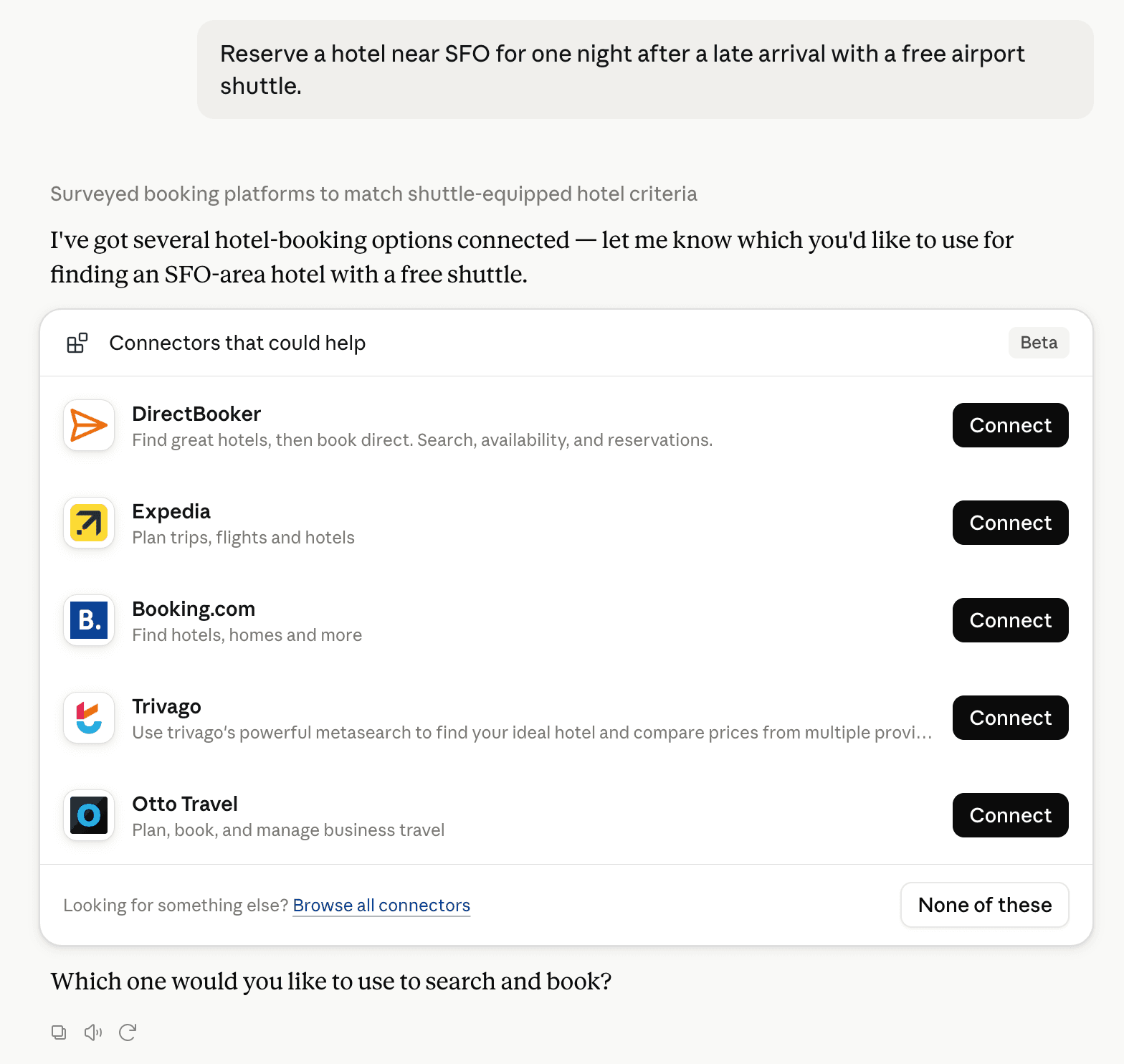
Claude can surface verified Connectors when they match a user’s Prompt.
How Claude Connector discovery works
Your Connector will compete to appear for users’ Prompts once Claude verifies it
Competing in Claude Databases & Backend Data Stores
View Category20 tools agents can invoke

Baseshift Claude Connector FAQ
How the directory, categories and Discoverability Score work.
Read the methodologyHow do I improve Baseshift's Claude Connector discoverability?
The levers are the listing surface agents actually read: names, descriptions, keywords, tool metadata, and registry health. Which lever matters depends on where discovery breaks, which is what continuous measurement shows.
What are Baseshift alternatives on Claude?
As of 2026-10-22, Baseshift competes with Airtable, MongoDB Atlas, Neon, PlanetScale, Supabase, AALY, Magicweave, MCPBackend and 3 more in Claude Databases & Backend Data Stores, ranked by public Discoverability Score.
Where is this profile measured?
This profile uses the geography attached to the latest public registry snapshot: US. Locale tags are intentionally omitted.