
Lucy - SEC Filings Search
Search U.S. SEC filings (10-K, 10-Q, 8-K, 20-F, 40-F, 6-K, DEF 14A, S-1, S-3) and ground Claude's answers in the actual disclosure passages, each with its SEC accession number.
 View in the Claude registry
- Brand
- Lucy
- Category
- Data & Analytics
- Primary Subcategory
- Institutional Financial Data & Equity Research Platforms
Integration details
Description
Lucy RAG is a retrieval layer for financial AI, built around how SEC filings are actually structured. Ask about a public company in plain language, and Lucy returns the most relevant passages from its SEC EDGAR filings so Claude can answer with citations instead of guessing from model memory. What it searches: Form 10-K, 10-Q, 8-K, 20-F, 40-F, 6-K, DEF 14A, S-1, and S-3 filings from 2016 onward, including amendments. Coverage keeps growing as new filings are added. How it works: - One read-only tool, rag_context. It takes a natural-language question and returns 20 to 40 filing passages, each with its text, a relevance score, and the SEC accession number of the filing it came from, plus a thread_id for follow-up questions in the same conversation. - Form-aware retrieval. Lucy first decides which company and which form to look at, then searches within that structure. Tables and footnotes stay intact. - Pre-processed filings. Key facts and structured data such as customer concentration come along with the passages. - Source-linked. Every passage carries its accession number. If nothing in the searched filings supports the question, Lucy returns no passages rather than guessing. - No write actions. Lucy never modifies any user or third-party data. Who it is for: analysts, investors, compliance and legal teams, and journalists who need answers grounded in what a company actually disclosed. Example questions: - How does Apple make money? - Why did Nvidia's profit grow so much in fiscal 2025? - What risk factors does Shopify disclose in its latest 40-F? - Who are Tesla's named executive officers and how is CEO pay structured? - Compare Apple's and Microsoft's discussion of AI-related risks in their 10-K filings. Getting access: Lucy is currently free. Sign up at lucydata.ai, request MCP access at https://lucydata.ai/solutions/rag, then connect and sign in with OAuth. One account works in every supported client. Operated by Ezar Inc. Support: [email protected].
- Integration type
- Connector
- Verification status
 Community connector
- Platform
- Claude
- Primary Subcategory
- Institutional Financial Data & Equity Research Platforms
- Secondary Subcategories
- None listed
- Brand
- Lucy
- Access
- Account required
- First tracked
- 2026-10-28
- Tool count
- 1
- Geography
- US
The Primary Subcategory used for this profile’s headline score.
Other Subcategories where the Integration is listed.
 Agent DiscoverabilityClaude Discoverability Score
Claude Connector discovery is coming soon
Community Connectors only appear in Claude’s registry.Once verified, organic discovery begins and we can calculate your score.Read more about Community Connector verification.
No spam. Unsubscribe any time.
What discovery looks like
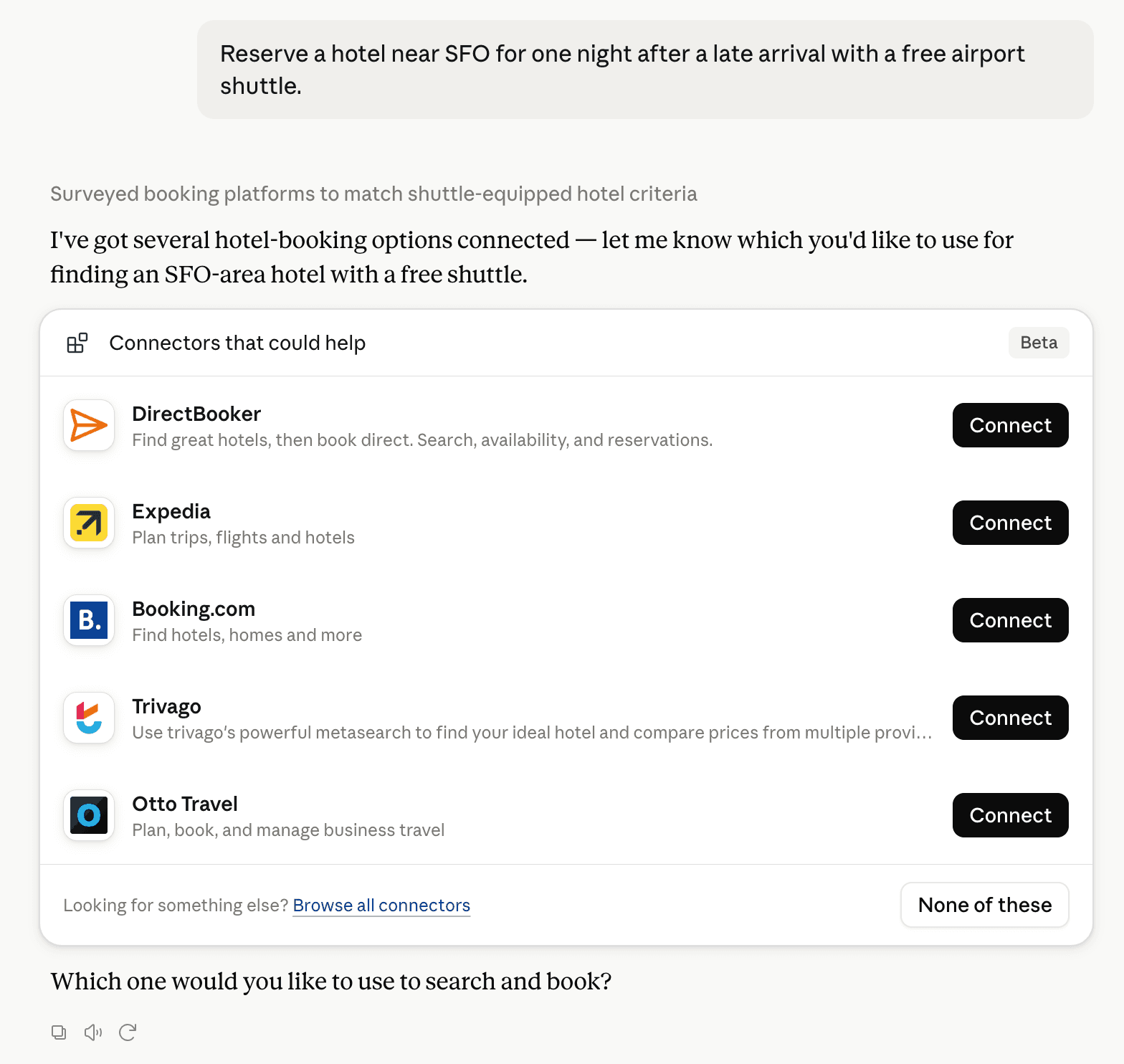
Claude can surface verified Connectors when they match a user’s Prompt.
How Claude Connector discovery works
Your Connector will compete to appear for users’ Prompts once Claude verifies it
Competing in Claude Institutional Financial Data & Equity Research Platforms
View Category1 tool agents can invoke

Lucy - SEC Filings Search Claude Connector FAQ
How the directory, categories and Discoverability Score work.
Read the methodologyHow do I improve Lucy - SEC Filings Search's Claude Connector discoverability?
The levers are the listing surface agents actually read: names, descriptions, keywords, tool metadata, and registry health. Which lever matters depends on where discovery breaks, which is what continuous measurement shows.
What are Lucy - SEC Filings Search alternatives on Claude?
As of 2026-10-28, Lucy - SEC Filings Search competes with Daloopa, Financial Datasets, Bigdata.com, FactSet AI-Ready Data, Alpha Vantage MCP Server, FMP, viaNexus vAST, Clear Street and 136 more in Claude Institutional Financial Data & Equity Research Platforms, ranked by public Discoverability Score.
Where is this profile measured?
This profile uses the geography attached to the latest public registry snapshot: US. Locale tags are intentionally omitted.