Anomity
Query your fleet's AI activity: MCP servers, shadow AI accounts, exposed secrets, agent permissions, and compliance posture - from any Claude conversation.
- Category
- Security
- Primary Subcategory
- Security & Compliance Posture Automation (GRC)
 View in the Claude registry
Integration details
Description
Anomity is an endpoint security and governance platform for agentic AI. A lightweight daemon on each managed device continuously inventories the AI tooling in use - MCP servers, coding agents, skills and instruction files, credentials, and account types - giving security teams visibility into a layer that sits between EDR and network controls. This connector lets you query that telemetry directly in Claude, without opening the console. What you can ask: Fleet overview - device counts by status (online, stale, offline) and open or critical finding counts across the fleet. MCP inventory - every MCP server detected across managed devices, grouped by trust level: official, community, or unknown-origin. AI accounts - which devices authenticate with corporate accounts versus personal ("shadow") accounts, plus data-sharing settings and BYOK configuration. Secret exposure - plaintext credentials found in AI configuration files, ranked by severity and pattern type. Capability surface - inferred permissions across MCP servers, flagging overprivileged devices and risky capability combinations. Skill and instruction-file risk - CLAUDE.md-class files and skills flagged by on-device content scanning for prompt injection, exfiltration patterns, and unsafe directives. Findings - policy violations filterable by status (open, acknowledged, resolved). Compliance status - readiness across SOC 2, ISO 42001, NIST AI RMF, and the EU AI Act, mapped to the controls each finding affects. Audit trail - 90 days of change history: every MCP server added or removed, every permission modified, on every device. Typical uses: investigating an alert without context-switching, preparing evidence for an audit, answering "which of our machines can reach production data through an agent?", or generating a weekly AI activity report. Anomity's approach is to govern rather than block - give teams the visibility to set informed policy instead of shutting down the tools developers are already using.
- Integration type
- Connector
- Verification status
 Community connector
- Platform
- Claude
- Primary Subcategory
- Security & Compliance Posture Automation (GRC)
- Secondary Subcategories
- None listed
- Brand
- Anomity
- Access
- Account required
- First tracked
- 2026-08-19
- Tool count
- 10
- Geography
- US
The Primary Subcategory used for this profile’s headline score.
Other Subcategories where the Integration is listed.
Claude Discoverability Score
Claude Connector discovery is coming soon
Community Connectors only appear in Claude’s registry.Once verified, organic discovery begins and we can calculate your score.Read more about Community Connector verification.
No spam. Unsubscribe any time.
No spam. Unsubscribe any time.
What discovery looks like
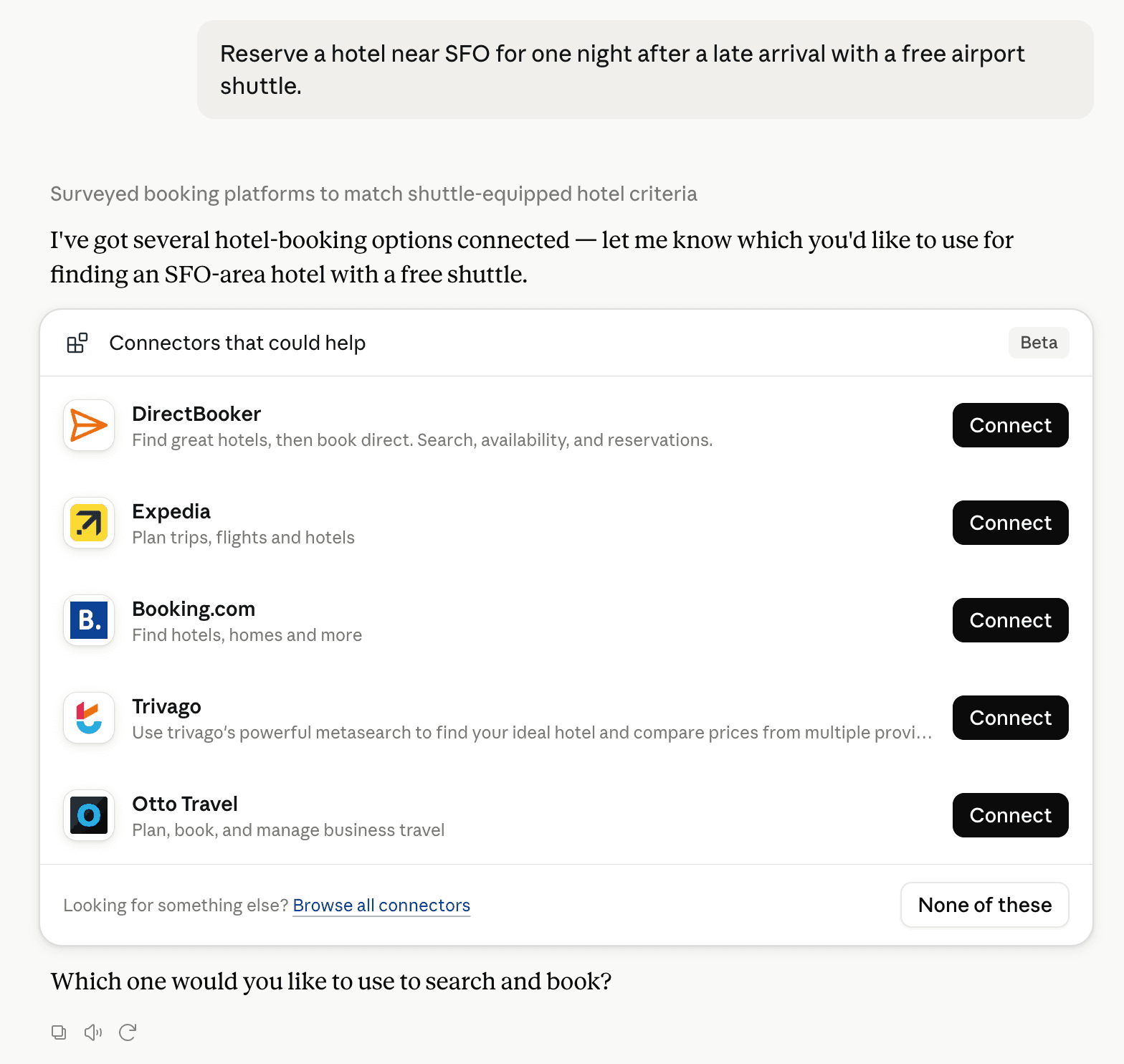
Claude can surface verified Connectors when they match a user’s Prompt.
How Claude Connector discovery works
Your Connector will compete to appear for users’ Prompts once Claude verifies it
Competing in Claude Security & Compliance Posture Automation (GRC)
View Category10 tools agents can invoke
How do I improve a Community connector's discoverability?
The levers are the listing surface agents actually read: names, descriptions, keywords, tool metadata, and registry health. Which lever matters depends on where discovery breaks, which is what continuous measurement shows.
What are Anomity alternatives on Claude?
As of 2026-09-13, Anomity competes with Sprinto MCP, Pi Security, Phished, accessibilitytracker.com, Ansvar AI, Assuric, CertScore.ai, CISO360AI, CISOGenie, Decionis Execution Authority, Drata, Dtwo, Norrsent - Agentic Risk Management & GRC, SAMMY, Sola Security, VComply in Claude Security & Compliance Posture Automation (GRC), ranked by public Discoverability Score.
Where is this profile measured?
This profile uses the geography attached to the latest public registry snapshot: US. Locale tags are intentionally omitted.