
LogMeIn Resolve
RMM and unified endpoint management (UEM) for IT teams and MSPs — manage devices, tickets, and alerts, start remote support, and connect Resolve with your other tools, right from Claude.
 View in the Claude registry
- Brand
- LogMeIn Resolve
- Category
- Pending
- Primary Subcategory
- Cloud Infrastructure Management
Integration details
Description
LogMeIn Resolve is a unified endpoint management (UEM) and remote monitoring and management (RMM) platform for internal IT teams and managed service providers (MSPs). This connector brings your Resolve environment into Claude, so you can ask about your fleet in plain language and act on the answer in the same place. What IT teams use it for: - See the whole estate at once — device health, alerts, and inventory across every account and tenant you manage, instead of clicking through them one by one - Cut alert noise — review what's firing, spot the pattern, and acknowledge in bulk - Automate the busywork — run scripts and Remote Execution jobs across the fleet, then check status without opening a separate console - Move tickets forward — read the queue, draft updates, and open tickets with the right service and priority already set - Answer hardware and software inventory questions on the spot — what's deployed, where, and on which version, across every device you manage - Capture what you learn — turn a resolved issue into a Knowledge Base article while the detail is still fresh - Start remote support faster — set up a session and send the invitation without leaving the conversation - Connect Resolve to your other tools — e.g., “Check this device's alert history in Resolve, then post a summary to our incident channel in Slack.” The connector is most valuable where endpoint data meets everything around it: correlating an alert with the ticket it produced, or turning device and ticket history into a report a client can read. It acts on behalf of the signed-in technician and stays within that user's existing Resolve permissions. Read actions never change data; creates, updates, and session actions are yours to approve. Requires a LogMeIn Resolve account. Learn more at logmein.com/products/resolve.
- Integration type
- Connector
- Verification status
 Community connector
- Platform
- Claude
- Category
- Pending
- Primary Subcategory
- Cloud Infrastructure Management
- Secondary Subcategories
- None listed
- Brand
- LogMeIn Resolve
- Access
- Account required
- First tracked
- 2026-10-01
- Tool count
- 77
- Geography
- US
The broad Category that contains the Primary Subcategory.
The Primary Subcategory used for this profile’s headline score.
Other Subcategories where the Integration is listed.
 Agent DiscoverabilityClaude Discoverability Score
Claude Connector discovery is coming soon
Community Connectors only appear in Claude’s registry.Once verified, organic discovery begins and we can calculate your score.Read more about Community Connector verification.
No spam. Unsubscribe any time.
No spam. Unsubscribe any time.
What discovery looks like
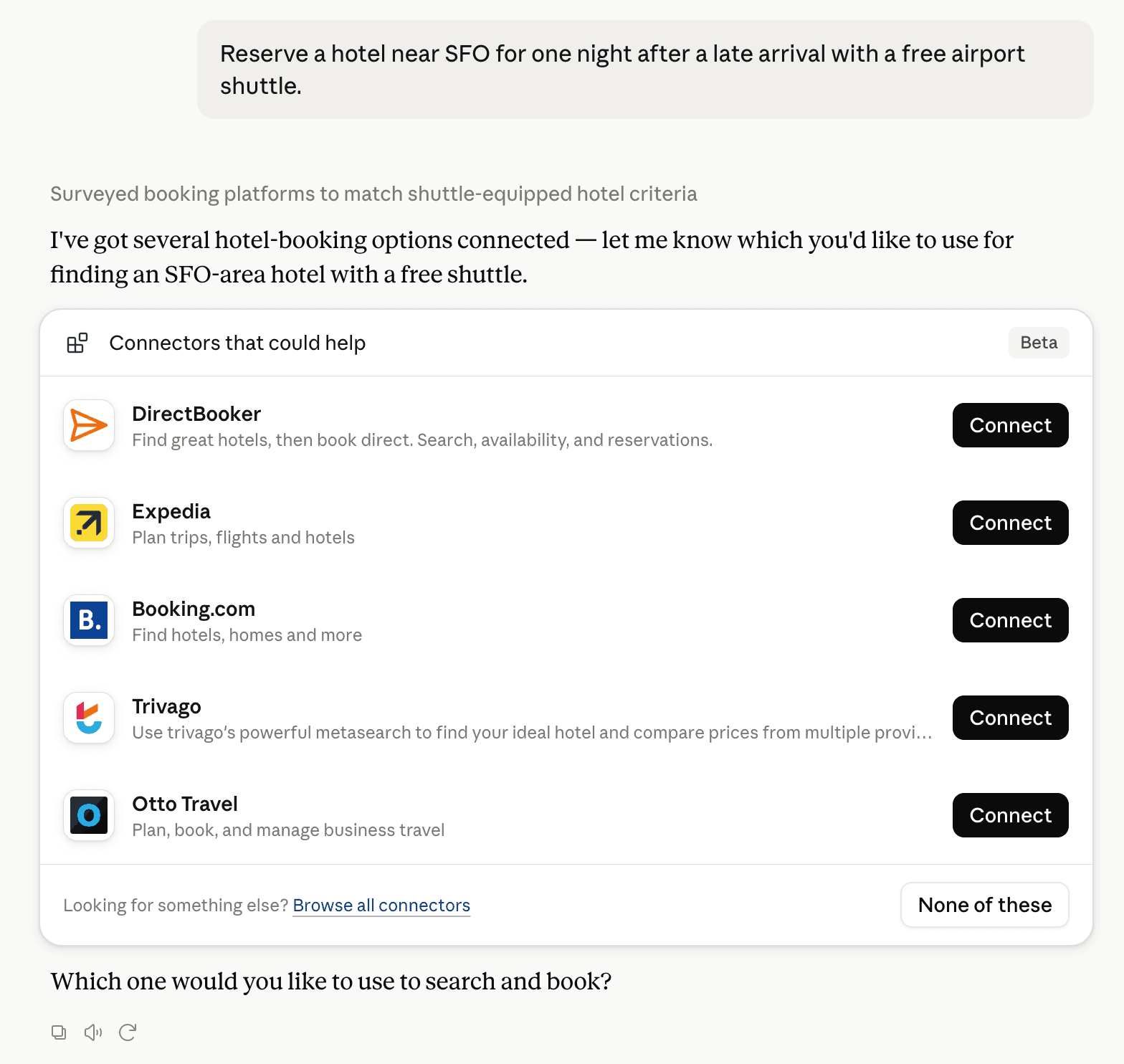
Claude can surface verified Connectors when they match a user’s Prompt.
How Claude Connector discovery works
Your Connector will compete to appear for users’ Prompts once Claude verifies it
Competing in Claude Cloud Infrastructure Management
View Category77 tools agents can invoke

LogMeIn Resolve FAQ
How the directory, categories and Discoverability Score work.
Read the methodologyHow do I improve a Community connector's discoverability?
The levers are the listing surface agents actually read: names, descriptions, keywords, tool metadata, and registry health. Which lever matters depends on where discovery breaks, which is what continuous measurement shows.
What are LogMeIn Resolve alternatives on Claude?
As of 2026-10-02, LogMeIn Resolve competes with AWS MCP, Datadog, Google Cloud BigQuery, Google Compute Engine, Render, Control Plane, Cloudflare Developer Platform, incident.io, Postman, Honeycomb, Railway, AWS Marketplace, Aiven MCP, ConoHa VPS, Hinode, mcp.webdock.io, NGP Cloud, PDQ Connect, Pingcore, Remote.It, Rescale, SimpleBackups, TurboStack, Viam in Claude Cloud Infrastructure Management, ranked by public Discoverability Score.
Where is this profile measured?
This profile uses the geography attached to the latest public registry snapshot: US. Locale tags are intentionally omitted.