
Visual Neuroscience
A detailed 3D atlas of the human brain: what each region and Brodmann area does, receptor density maps and brain states, with every answer linking into the atlas.
 View in the Claude registry
- Category
- Education
- Primary Subcategory
- Scientific & Biomedical Research Data
Integration details
Description
VisualNeuroscience.AI is a free, detailed 3D atlas of the human brain on the web, iPhone, iPad, Mac and Apple Vision Pro. This connector answers from the atlas's own data, and every answer carries a link that opens the same view in the atlas. Ask which parts of the brain recognise faces, what Brodmann area 44 does and what borders it, where dopamine D2 receptors are densest, or how the brain's networks change in a flow state. Five tools work without an account: Search the brain atlas: regions, Brodmann areas, network nodes and receptor structures, by name, number or function. About one brain region: what each AAL-116 region does and which layer of the brain it belongs to. About one Brodmann area: name, lobe, function and measured neighbours for all 41 areas. Receptor density in a structure: in vivo PET and ex vivo autoradiography across 45 regions, each value with its tracer, sample and citation. A brain state as a network story: six states, from rest and focused attention to threat and flow, with the studies each one is drawn from. Four more work on your own VisualNeuroscience.AI account once you sign in on the site and press Allow: see which account is connected, list and open your saved Region Atlas models, and save a new model, which then appears in the app on every device. Saving only ever creates; nothing is replaced or deleted. The data comes from published sources: the AAL-116 parcellation on the MNI152 template, the Brodmann areas of the MRIcron atlas, and receptor maps from Hansen et al. 2022 and Zilles and Palomero-Gallagher 2017. The server keeps no record of your questions. The atlas is educational reference material, not medical advice.
- Integration type
- Connector
- Verification status
 Community connector
- Platform
- Claude
- Primary Subcategory
- Scientific & Biomedical Research Data
- Secondary Subcategories
- None listed
- Access
- No account required
- First tracked
- 2026-10-17
- Tool count
- 9
- Geography
- US
The Primary Subcategory used for this profile’s headline score.
Other Subcategories where the Integration is listed.
 Agent DiscoverabilityClaude Discoverability Score
Claude Connector discovery is coming soon
Community Connectors only appear in Claude’s registry.Once verified, organic discovery begins and we can calculate your score.Read more about Community Connector verification.
No spam. Unsubscribe any time.
No spam. Unsubscribe any time.
What discovery looks like
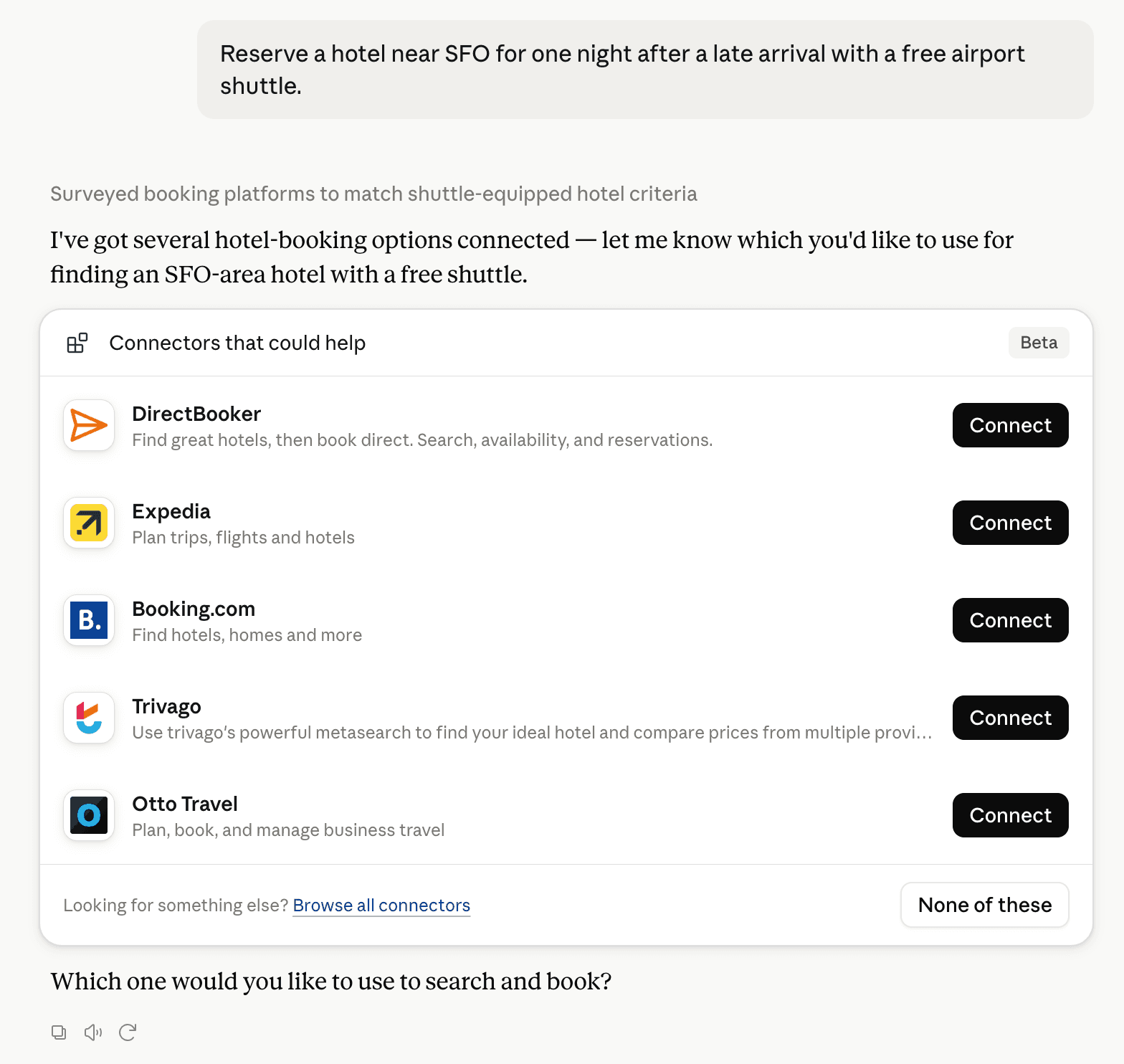
Claude can surface verified Connectors when they match a user’s Prompt.
How Claude Connector discovery works
Your Connector will compete to appear for users’ Prompts once Claude verifies it
Competing in Claude Scientific & Biomedical Research Data
View Category
9 tools agents can invoke

Visual Neuroscience Claude Connector FAQ
How the directory, categories and Discoverability Score work.
Read the methodologyHow do I improve Visual Neuroscience's Claude Connector discoverability?
The levers are the listing surface agents actually read: names, descriptions, keywords, tool metadata, and registry health. Which lever matters depends on where discovery breaks, which is what continuous measurement shows.
What are Visual Neuroscience alternatives on Claude?
As of 2026-10-18, Visual Neuroscience competes with Amass Connector, Boltz API, Synthesize Bio, Atomscale, Benchling, ChEMBL, Cheméo, Chemical and Physical Properties, Clinical Trials and 25 more in Claude Scientific & Biomedical Research Data, ranked by public Discoverability Score.
Where is this profile measured?
This profile uses the geography attached to the latest public registry snapshot: US. Locale tags are intentionally omitted.