
Climate Insights Directory
Free, no API key. Discover what civil-society reports, policy briefs and analyses say about climate and energy, improve your desk research for policy, finance, scholarship, and journalism.
 View in the Claude registry
- Category
- Data & Analytics
- Primary Subcategory
- Academic Literature & Citation Search
Integration details
Description
**What kind of data can you use?** Climate Insights Directory is a free, open index of over 40,000 climate and energy publications by global civil society organizations, such as NGOs, think tanks and research centers. No account or API key is needed. Use it to find reports, policy briefs and analyses on topics such as energy transition, fossil fuel phase-out, climate policy and finance, and regional perspectives on climate adaptation. The database is particularly well-suited for: * Policy researchers looking for geography-specific evidence related to environmental issues * Researchers evaluating risk for climate, energy, transport, and other industrial investments in investing or insurance. * Academics evaluating positions of climate organizations and the climate movement * Journalists putting recent disasters, policy events or climate news in-context of previous research **What is included?** The V1 of the connector includes two read-only tools: * search: full-text search over the index, with filters for publisher, geography, topic tags, document type, language and publication date, and a choice of response format. * fetch: returns one record by its id, with its title, text, URL and metadata. Data returned is metadata records for evidence based reports and analysis. Every document identifier in our collection carries metadata, AI-written summaries and a source URL to the original publisher. Our preferred citation includes the original publisher and "via Climate Insights Directory". The Climate Insights Directory does not include datasets, and it does not return time series. Related collections include Climate Policy Radar. Full documents are on the websites of the original publishers; each record links to the original document. Documentation: https://climateinsightsdirectory.org/api-docs#mcp Privacy policy: https://climateinsightsdirectory.org/privacy-policy Support: [email protected]
- Integration type
- Connector
- Verification status
 Community connector
- Platform
- Claude
- Primary Subcategory
- Academic Literature & Citation Search
- Secondary Subcategories
- None listed
- Access
- No account required
- First tracked
- 2026-10-29
- Tool count
- 2
- Market
- US
The Primary Subcategory used for this profile’s headline score.
Other Subcategories where the Integration is listed.
 Agent DiscoverabilityClaude Discoverability Score
Claude Connector discovery is coming soon
Community Connectors only appear in Claude’s registry.Once verified, organic discovery begins and we can calculate your score.Read more about Community Connector verification.
No spam. Unsubscribe any time.
What discovery looks like
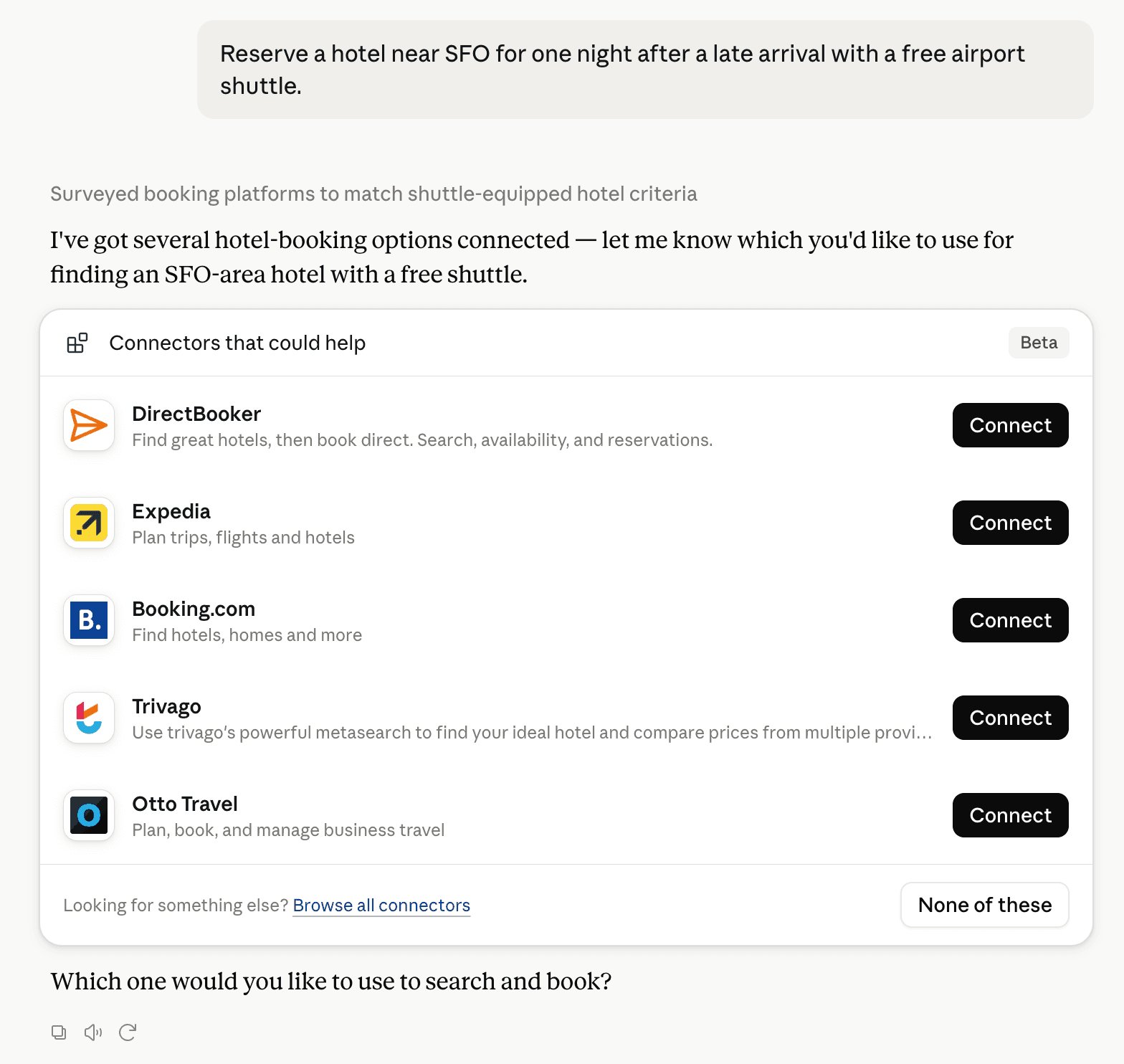
Claude can surface verified Connectors when they match a user’s Prompt.
How Claude Connector discovery works
Your Connector will compete to appear for users’ Prompts once Claude verifies it
Competing in Claude Academic Literature & Citation Search
View Category
2 tools agents can invoke

Climate Insights Directory Claude Connector FAQ
How the directory, categories and Discoverability Score work.
Read the methodologyHow do I improve Climate Insights Directory's Claude Connector discoverability?
The levers are the listing surface agents actually read: names, descriptions, keywords, tool metadata, and registry health. Which lever matters depends on where discovery breaks, which is what continuous measurement shows.
What are Climate Insights Directory alternatives on Claude?
As of 2026-10-30, Climate Insights Directory competes with Wiley Scholar Gateway, Firecrawl, alphaXiv, bioRxiv, Consensus, Elicit, Find Research, Lacuna Research and 9 more in Claude Academic Literature & Citation Search, ranked by public Discoverability Score.
Where is this profile measured?
This profile uses the geography attached to the latest public registry snapshot: US. Locale tags are intentionally omitted.