
Rollcage
Check shell commands, files and URLs against Rollcage’s agent guard rules. Free, no sign-in.
 View in the Claude registry
- Brand
- Rollcage
- Category
- Security
- Primary Subcategory
- Application Security & Vulnerability Management
Integration details
Description
Rollcage gives Claude a safety check to run before it acts. Before it runs a shell command, opens a file or sends data to a site, Claude can ask Rollcage whether the action would be blocked, needs your approval, or is fine, and why. Rollcage uses the rules of rollcage-guard, an open-source project (MIT licence), with their default settings. The server is free and public, needs no account or API key, and stores nothing. It runs on rollcage.app, so it can’t see or change anything on your machine. Tools check_command: takes a shell command and returns block, ask or allow, with the reason. It never runs the command. Blocks: reading secret files commands that print environment variables (env, printenv, echo $API_KEY) one-line scripts that read environment variables (python -c, node -e…) rm -rf ~, git clean -f, DROP DATABASE, erasing disks uploads to paste, file-drop and tunnel sites Asks first: git reset --hard, force pushes, pushes to main or production curl | sh, sudo, terraform destroy deleting cloud resources, DELETE requests to remote APIs connecting to remote databases check_file: checks a list of paths and says which are secret files an agent shouldn’t read: .env files, keys and certificates, cloud credentials, service-account JSON, Terraform state, ~/.ssh, ~/.aws. Templates such as .env.example are allowed. check_url: checks a URL or host against the list of paste, file-drop, request-capture and tunnel sites (pastebin, transfer.sh, webhook.site, ngrok, trycloudflare…), which are the usual way keys and code leave a machine. It can also apply a stricter mode that only allows listed sites. list_rules: the full default rule set, with an action for each rule. Claude uses it to explain why something was flagged. install_guard: install steps for the local rollcage-guard hook, which enforces the same rules on every tool call in Claude Code, Codex CLI, Cursor and Gemini CLI, plus the hook entry for each agent’s config file. search_docs / get_doc: Rollcage’s guides to ru
- Integration type
- Connector
- Verification status
 Community connector
- Platform
- Claude
- Primary Subcategory
- Application Security & Vulnerability Management
- Secondary Subcategories
- None listed
- Brand
- Rollcage
- Access
- No account required
- First tracked
- 2026-10-15
- Tool count
- 8
- Geography
- US
The Primary Subcategory used for this profile’s headline score.
Other Subcategories where the Integration is listed.
 Agent DiscoverabilityClaude Discoverability Score
Claude Connector discovery is coming soon
Community Connectors only appear in Claude’s registry.Once verified, organic discovery begins and we can calculate your score.Read more about Community Connector verification.
No spam. Unsubscribe any time.
No spam. Unsubscribe any time.
What discovery looks like
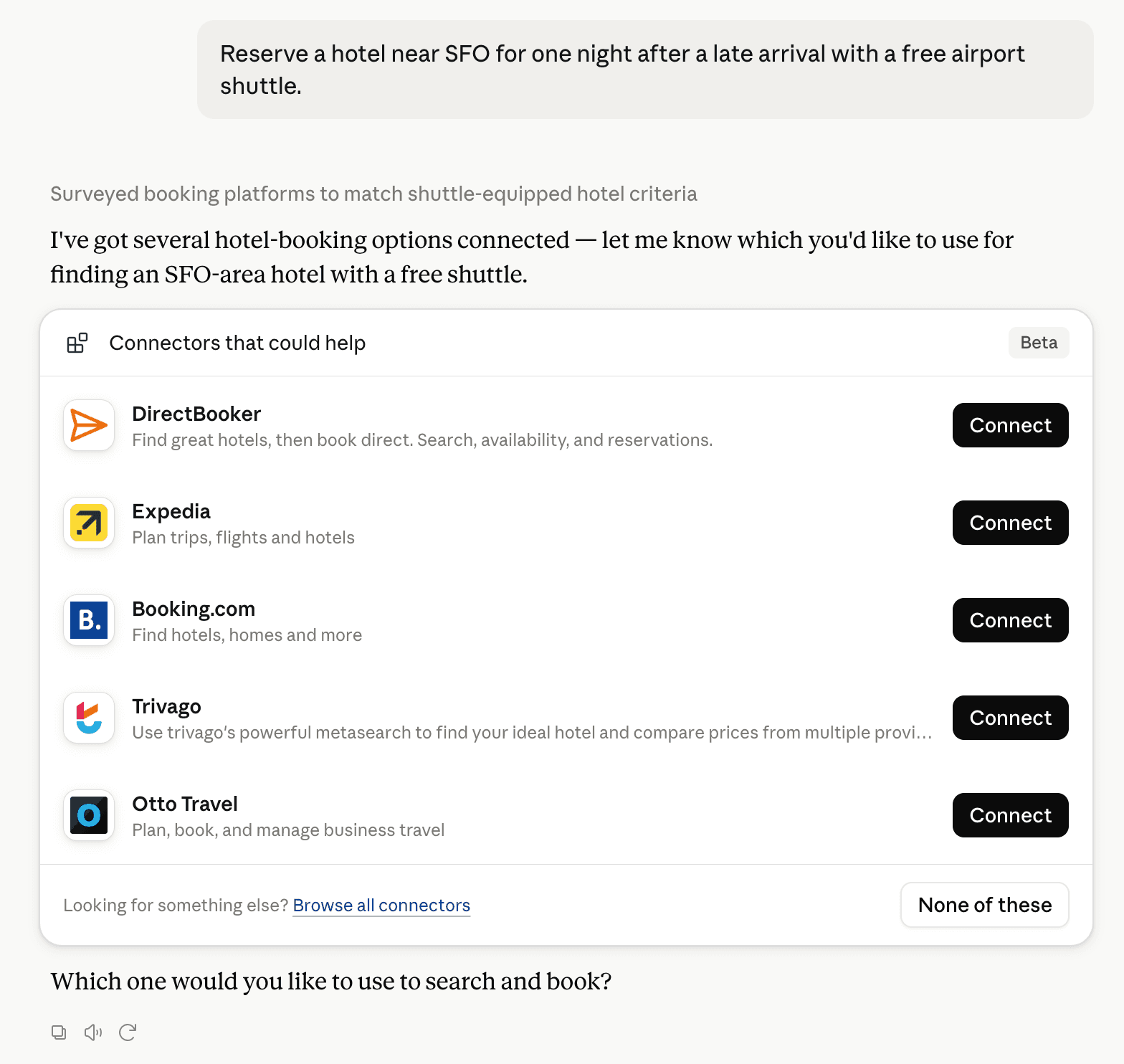
Claude can surface verified Connectors when they match a user’s Prompt.
How Claude Connector discovery works
Your Connector will compete to appear for users’ Prompts once Claude verifies it
Competing in Claude Application Security & Vulnerability Management
View Category8 tools agents can invoke

Rollcage Claude Connector FAQ
How the directory, categories and Discoverability Score work.
Read the methodologyHow do I improve Rollcage's Claude Connector discoverability?
The levers are the listing surface agents actually read: names, descriptions, keywords, tool metadata, and registry health. Which lever matters depends on where discovery breaks, which is what continuous measurement shows.
What are Rollcage alternatives on Claude?
As of 2026-10-16, Rollcage competes with CloudBees Unify MCP Server, ActiveLayer, Affirmed AI, AgentAvow, Apiiro Guardian, Arcjet, Assurly, atlasFindings and 20 more in Claude Application Security & Vulnerability Management, ranked by public Discoverability Score.
Where is this profile measured?
This profile uses the geography attached to the latest public registry snapshot: US. Locale tags are intentionally omitted.